

Laminate Tubes for Retinol Cream
Custom laminate tubes for retinol creams, retinoid treatments, anti-aging night creams and active facial skincare. Xinfly Packaging manufactures ABL, PBL and EVOH barrier tubes with customizable light protection, oxygen barrier, precision dispensing and premium decoration.
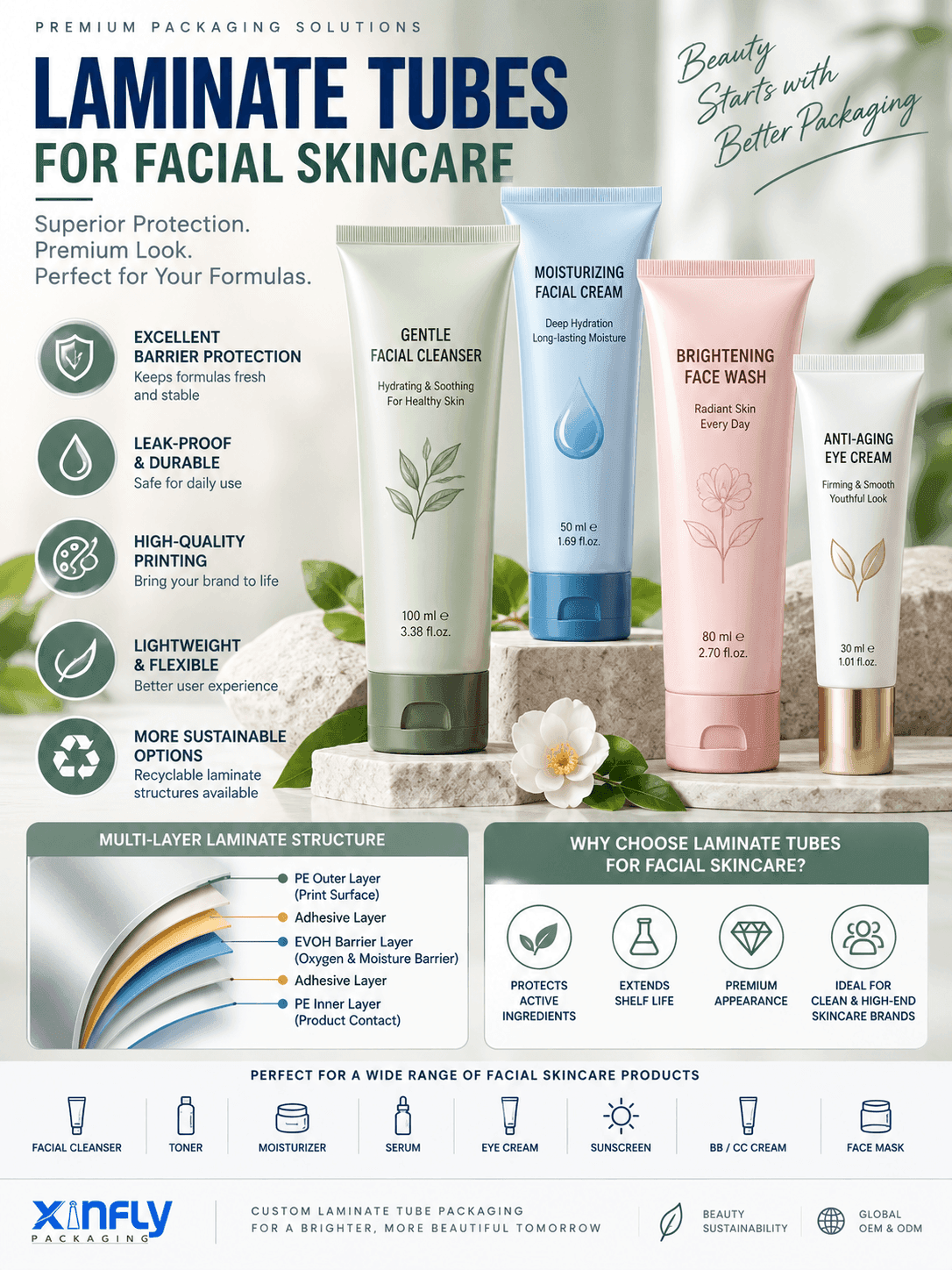
Barrier Packaging for Retinol Skincare
Retinol and retinoid skincare products often require more careful packaging evaluation than basic facial moisturizers. Formula stability can be influenced by the complete ingredient system, environmental exposure and packaging compatibility.
The ideal retinol cream tube should therefore be selected according to the finished formulation, required oxygen and light protection, viscosity, dosage and intended shelf life.
ABL, PBL and EVOH laminate structures provide different combinations of barrier performance, squeeze characteristics and premium appearance.
Discuss Your Retinol FormulaLight Protection
Opaque or high-barrier structures can reduce unnecessary light exposure.
Oxygen Barrier
ABL and EVOH-based structures provide enhanced oxygen barrier options.
Precision Dispensing
Smaller dispensing openings can help control the application of concentrated skincare.
Premium Appearance
Matte, soft-touch and metallic decoration support premium anti-aging positioning.
Retinol Products Suitable for Laminate Tubes
Tube specifications can be adapted for different retinoid skincare formats, viscosities and dosage requirements.
Retinol Cream
Daily or nighttime retinol facial creams.
Retinol Night Cream
Rich overnight anti-aging formulations.
Retinol Eye Cream
Precision packaging for small-dose eye treatments.
Retinoid Treatment
Targeted facial treatment formulations.
Retinal Cream
Premium retinal-containing skincare formulas.
Retinol Moisturizer
Moisturizing formulas with retinol actives.
Anti-Wrinkle Cream
Retinol-based mature-skin treatments.
Retinol Body Treatment
Larger-capacity retinol creams for targeted body care.
ABL vs PBL vs EVOH Tubes for Retinol Cream
Barrier performance should be selected according to the actual retinol formulation and validated through filled-package testing.
ABL Retinol Cream Tubes
Aluminum Barrier Laminate is a strong option when enhanced oxygen and light barrier are priorities for the finished formulation.
- Excellent oxygen barrier
- Excellent light barrier
- Opaque barrier layer
- Suitable for sensitive formulations
PBL Retinol Cream Tubes
Plastic Barrier Laminate provides a smooth premium appearance and good decoration performance. Barrier configuration should be matched to the formula's stability requirements.
- Premium appearance
- Excellent artwork reproduction
- Good squeeze recovery
- Multiple barrier configurations
EVOH Retinol Cream Tubes
EVOH multilayer tubes provide enhanced oxygen barrier performance while retaining flexible PE-based squeeze characteristics.
- Strong oxygen barrier
- Flexible squeeze feel
- Good shape recovery
- Suitable for modern skincare packaging
Retinol Tube Barrier Selection Guide
Do not select packaging solely from the ingredient name. The complete formulation and stability target should determine the final tube structure.
| Tube Structure | Oxygen Barrier | Light Protection | Squeeze Feel | Best Considered For |
|---|---|---|---|---|
| ABL | Excellent | Excellent | Moderate | Formulas requiring strong barrier protection |
| PBL | Depends on structure | Depends on opacity/design | Good | Premium skincare appearance and decoration |
| EVOH Multilayer | Strong | Depends on pigmentation | Soft / Flexible | Flexible oxygen-barrier skincare tubes |
How to Choose Laminate Tubes for Retinol Cream
Start with the finished retinol formulation, then engineer the barrier, dispensing system and decoration around its actual requirements.
Review the Complete Formula
Identify the retinoid system, oils, antioxidants, emulsifiers and other relevant ingredients.
Define Stability Targets
Review the required protection from oxygen, light and environmental exposure.
Choose Barrier Structure
Compare ABL, PBL and EVOH according to formula requirements.
Control Product Dosage
Select the opening size according to viscosity and intended application amount.
Choose Opaque Decoration
Where required, use suitable pigmentation or opaque laminate structures to reduce light transmission.
Test Filled Samples
Validate compatibility, stability, dispensing and sealing before mass production.
Precision Dispensing for Retinol Cream
Controlled dispensing can be especially useful for concentrated facial treatments and small application areas.
| Retinol Product | Texture | Suggested Starting Point | Packaging Goal |
|---|---|---|---|
| Retinol Eye Treatment | Light Cream | Approx. 1–1.5 mm | Precision dosage |
| Retinol Treatment Cream | Low–Medium | Approx. 1.5–2 mm | Controlled application |
| Retinol Face Cream | Medium | Approx. 2–3 mm | Balanced dispensing |
| Rich Retinol Night Cream | Medium–High | Approx. 3–5 mm | Comfortable squeeze |
Recommended Retinol Cream Tube Sizes
Smaller capacities are particularly useful for concentrated facial treatments, while 30–50 ml formats suit broader daily facial application.
| Capacity | Typical Application | Suggested Diameter | Positioning |
|---|---|---|---|
| 5–10 ml | Sample / Targeted Treatment | Φ16–19 mm | Trial / Precision |
| 15 ml | Retinol Eye Cream | Φ19–22 mm | Targeted Treatment |
| 20–30 ml | Retinol Treatment Cream | Φ22–30 mm | Premium Active Care |
| 40–50 ml | Retinol Face / Night Cream | Φ30–35 mm | Main Retail Size |
| 60–75 ml | Large Retinol Moisturizer | Φ35–40 mm | Extended Use |
Engineer Recommendations for Retinol Cream Tubes
Retinol packaging should not be selected only by copying another brand's package.
The retinoid derivative, complete formula, stability target, viscosity and intended shelf life should guide material selection.
Ask an EngineerBarrier requirements should be based on stability testing of the complete formulation.
If light protection is required, evaluate opaque structures or suitable pigmentation.
A smaller opening can help users dispense a more consistent amount of product.
Compatibility evaluation should consider all packaging components in contact with the formula.
Rich retinol night creams may require a softer tube and less restrictive flow path.
Final evaluation should use the intended laminate, closure, decoration and filled formula.
Retinol Formula Compatibility & Packaging Tests
Filled-package validation should be completed before approving a retinol tube for commercial production.
Compatibility Test
Evaluate interaction between the finished formula and tube, shoulder and closure.
Accelerated Storage
Assess packaging and formula behavior under appropriate accelerated conditions.
Light Exposure Evaluation
Where relevant, compare packaging structures under the required light-protection protocol.
Dispensing Test
Confirm squeeze force, dosage control and product cut-off.
Leakage Test
Check closure fit and tail-seal integrity using filled samples.
Filling-Line Trial
Validate filling nozzle, eye mark, tail sealing and production parameters.
Common Retinol Cream Packaging Problems
These issues can often be reduced through formula-specific package development and testing.
Insufficient Light Protection
A visually attractive package may not provide the opacity required by the actual formulation.
Insufficient Oxygen Barrier
Barrier performance should be matched to the product's validated stability requirements.
Opening Is Too Large
Concentrated retinol treatments may dispense more product than intended.
Formula-Package Interaction
The finished formulation may interact differently with tube, shoulder or closure materials.
Rich Cream Is Hard to Dispense
Tube stiffness and a restrictive opening can increase squeeze force.
Decoration Fails During Use
Matte coatings, printing and metallic effects should withstand repeated tube deformation.
Custom Retinol Cream Tube Specifications
Xinfly Packaging can customize barrier structure, capacity, diameter, tube softness, opacity, closure, dispensing opening and decoration.
For retinol and other active-rich formulas, provide the complete formula characteristics, target shelf life and filling information before final packaging approval.
Request Technical SupportRetinol Cream Tube Buyer Checklist
Provide these details for a more accurate laminate tube recommendation.
Retinol, retinal or other retinoid-based formulation.
Provide relevant ingredients and formula characteristics.
Provide measured viscosity and test temperature if available.
For example 15 ml, 20 ml, 30 ml or 50 ml.
Oxygen, light or other stability-related requirements.
Precision nozzle, screw cap, flip-top or custom opening.
Artwork, Pantone colors, matte, soft touch and metallic effects.
Provide estimated quantity and required delivery schedule.
Why Choose Xinfly Packaging for Retinol Cream Tubes
Barrier-focused laminate tube development for active skincare and premium anti-aging brands.
Barrier Material Expertise
ABL, PBL and EVOH options for formula-specific requirements.
Light Protection Options
Opaque and pigmented structures can be developed where required.
Precision Dispensing
Multiple opening sizes for concentrated facial treatments.
Premium Decoration
Matte, soft touch, CMYK, silk screen and hot stamping options.
Sample Development
Samples support compatibility, dispensing and artwork evaluation.
OEM & ODM Support
Support for skincare brands, private labels and contract manufacturers.
Explore Related Facial Skincare Packaging
Build a complete active-skincare packaging platform around retinol, anti-aging and overnight facial care.
Anti-Aging Cream Tubes
Explore laminate packaging for peptide, firming, wrinkle-care and premium anti-aging creams.
View Anti-Aging Tubes
Night Cream Tubes
Explore laminate tubes for rich overnight moisturizers and intensive facial treatments.
View Night Cream Tubes
Facial Skincare Tubes
Explore the complete laminate tube platform for facial creams, cleansers and active skincare.
View Facial Skincare
Retinol Cream Laminate Tube FAQ
Common questions from skincare brands sourcing custom retinol cream packaging.
Are laminate tubes suitable for retinol cream?
Which tube material is best for retinol cream?
Is ABL suitable for retinol cream?
Are EVOH tubes suitable for retinol skincare?
Does retinol cream packaging need to block light?
What size tube is common for retinol cream?
What orifice size is suitable for retinol cream?
Can retinol tubes have a precision nozzle?
Can retinol tubes have a soft-touch finish?
Should retinol cream be tested in the final tube?
What is the MOQ for custom retinol cream tubes?
Can Xinfly provide samples for compatibility testing?
Develop Your Custom Retinol Cream Tube
Send Xinfly Packaging your retinoid type, complete formula characteristics, viscosity, target capacity, barrier requirements, preferred ABL, PBL or EVOH structure, closure, dispensing opening, artwork and estimated quantity. Our team can help evaluate a suitable laminate tube for your retinol skincare project.