

Laminate Tubes for Face Cream
Custom laminate tubes for moisturizing face cream, anti-aging cream, barrier repair cream, retinol cream, vitamin C cream and other premium facial skincare formulas. Xinfly Packaging manufactures ABL, PBL and EVOH barrier tubes with customizable squeeze softness, dispensing openings, closures and premium decoration.
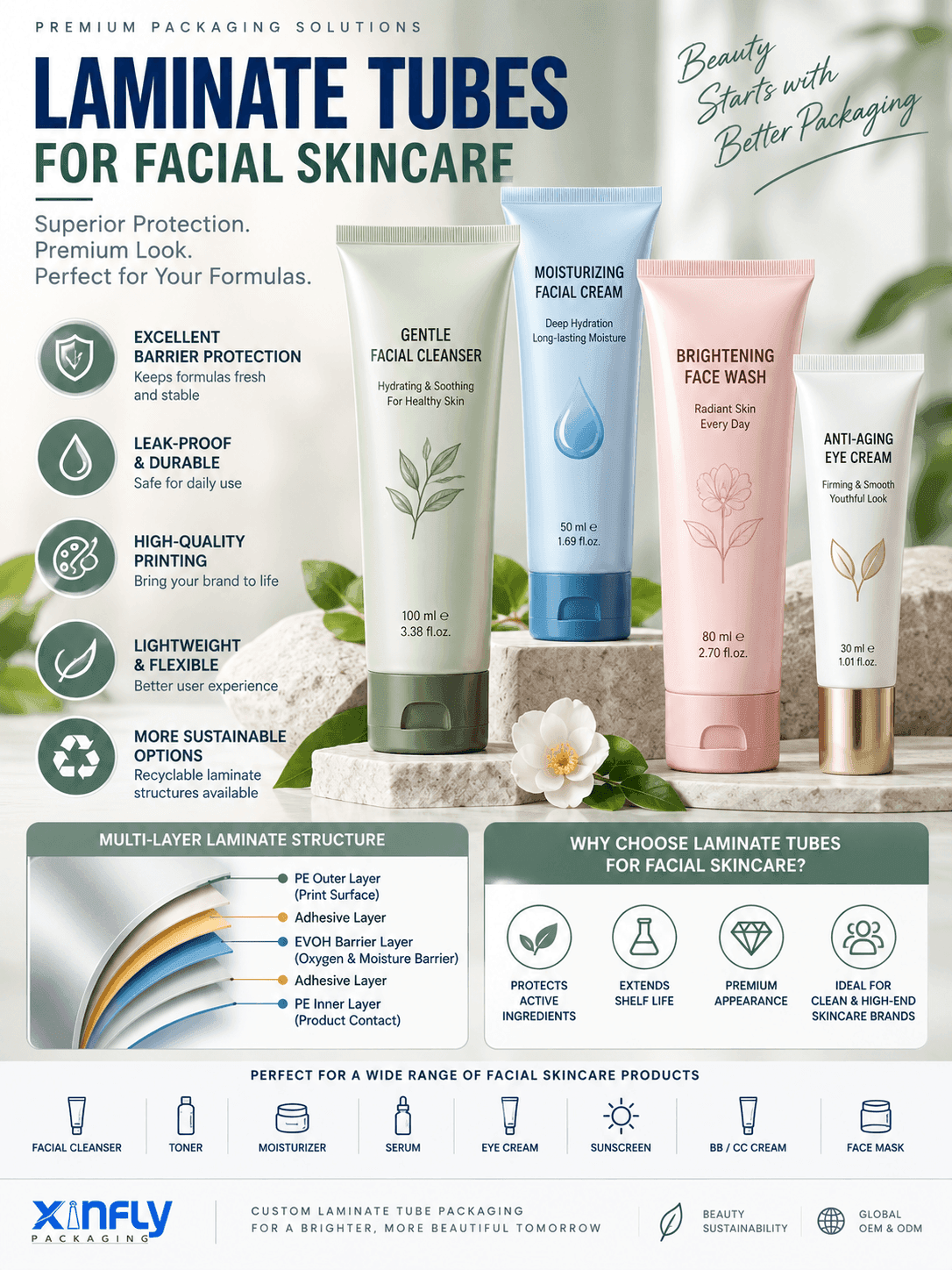
Premium Barrier Packaging for Face Cream
Face creams can range from lightweight daily moisturizers to rich barrier-repair creams and active-rich anti-aging formulas. Their packaging requirements therefore vary significantly.
The right tube should protect the formula, provide comfortable squeezing, control product dosage and support the premium presentation expected from facial skincare.
ABL, PBL and EVOH laminate structures provide different combinations of barrier performance, flexibility and cosmetic appearance.
Discuss Your Face Cream FormulaFormula Protection
Barrier structures can be selected according to ingredient sensitivity and shelf-life goals.
Soft Squeeze Feel
Tube flexibility can be optimized for medium and rich cream textures.
Controlled Dosage
Orifice size can be matched to cream viscosity and desired application amount.
Premium Decoration
Matte, soft touch, hot stamping and high-quality printing support premium skincare brands.
Face Cream Products Suitable for Laminate Tubes
Laminate tubes can support both everyday moisturizers and more specialized active-rich facial cream formulas.
Daily Moisturizer
Light to medium facial moisturizing creams.
Barrier Repair Cream
Rich creams for dry and sensitive skin.
Anti-Aging Cream
Premium treatment creams with active ingredients.
Retinol Cream
Barrier-focused packaging for retinoid skincare.
Vitamin C Cream
Antioxidant skincare and brightening formulas.
Night Cream
Rich overnight facial treatment products.
Day Cream
Daily skincare cream and moisturizer packaging.
Sensitive Skin Cream
Gentle skincare and barrier-support formulations.
Best Laminate Tube Materials for Face Cream
Material should be selected according to formula sensitivity, cream texture, barrier performance and premium appearance.
ABL Face Cream Tubes
Aluminum Barrier Laminate offers excellent oxygen and light barrier performance for formulas requiring enhanced environmental protection.
- Excellent oxygen barrier
- Excellent light barrier
- Suitable for sensitive formulas
- Strong barrier performance
PBL Face Cream Tubes
Plastic Barrier Laminate provides good barrier performance, smooth tube walls and excellent artwork reproduction.
- Premium cosmetic appearance
- Good squeeze recovery
- Excellent printing surface
- Suitable for high-end skincare
EVOH Face Cream Tubes
EVOH multilayer tubes combine strong oxygen barrier performance with soft PE-based squeeze characteristics.
- Strong oxygen barrier
- Soft squeeze feel
- Good shape recovery
- Modern skincare positioning
How to Choose Laminate Tubes for Face Cream
Start with the actual face cream formula, then determine the barrier structure, tube softness, capacity and dispensing system.
Review the Formula
Identify oils, active ingredients, antioxidants, retinoids, acids and other relevant components.
Measure Cream Viscosity
Lightweight moisturizer and rich night cream require different squeezing and dispensing specifications.
Select Barrier Level
Compare ABL, PBL and EVOH according to formula sensitivity and required protection.
Choose Tube Softness
Rich creams may benefit from a softer tube to reduce squeeze force and improve product evacuation.
Select Closure & Orifice
Match dispensing to desired dosage, viscosity and consumer-use experience.
Test the Filled Package
Validate compatibility, leakage, dispensing and sealing before mass production.
Face Cream Viscosity & Tube Selection
Texture is one of the most important factors affecting tube softness, opening diameter and product evacuation.
| Face Cream Type | Typical Texture | Packaging Focus | Recommended Validation |
|---|---|---|---|
| Light Moisturizer | Low–Medium | Controlled dispensing | Flow & leakage test |
| Daily Face Cream | Medium | Balanced squeeze + dosage | Dispensing test |
| Barrier Repair Cream | Medium–High | Soft tube + larger flow path | Squeeze-force test |
| Rich Night Cream | High | Product evacuation | End-of-use test |
Choosing the Right Orifice for Face Cream Tubes
Orifice size should balance dosage control with comfortable squeezing and complete product evacuation.
| Formula | Viscosity | Suggested Starting Point | Main Goal |
|---|---|---|---|
| Light Face Lotion | Low–Medium | Approx. 1.5–2 mm | Controlled dosage |
| Daily Face Cream | Medium | Approx. 2–3 mm | Balanced output |
| Rich Moisturizer | Medium–High | Approx. 3–5 mm | Reduce squeeze resistance |
| Dense Balm-Like Cream | High | Custom larger opening | Improve evacuation |
Recommended Sizes for Face Cream Tubes
Capacity should match product positioning, consumer usage frequency and target retail format.
| Capacity | Typical Use | Suggested Diameter | Positioning |
|---|---|---|---|
| 15–20 ml | Travel / Treatment Cream | Φ19–25 mm | Mini / Trial |
| 30 ml | Active Face Cream | Φ25–30 mm | Premium Treatment |
| 40–50 ml | Daily Moisturizer | Φ30–35 mm | Main Retail Size |
| 60–75 ml | Rich Face Cream | Φ35–40 mm | Extended Use |
| 80–100 ml | Large Face / Multi-Use Cream | Φ35–40 mm | Large Retail Format |
Engineer Recommendations for Face Cream Tubes
Face cream packaging should be developed around the actual texture, actives and consumer dosage.
A premium tube should not only look good; it should also remain easy to squeeze from first use to the last application.
Ask an EngineerA basic moisturizer and an active-rich retinol cream may require very different barrier performance.
Thick barrier creams can become frustrating to use when paired with an unnecessarily rigid tube.
Too much output can reduce dosage control, create cap residue and increase product waste.
Compatibility evaluation should include the tube body, shoulder, closure and any internal components.
Rich cream can remain trapped near the shoulder if the tube geometry and flexibility are poorly matched.
Matte, soft-touch, silk-screen and hot-stamping performance should be checked after repeated squeezing.
Face Cream Formula Compatibility Testing
Final packaging suitability should be confirmed with the actual commercial formula before mass production.
Formula Contact Test
Evaluate tube and closure components after contact with the actual face cream formula.
Heat Storage
Check package and cream behavior under elevated-temperature storage.
Dispensing Test
Measure squeeze force, product output and cut-off cleanliness.
Leakage Test
Evaluate closure fit and tail-seal performance with filled tubes.
Decoration Test
Check printing and coating adhesion after repeated squeezing and storage.
Filling-Line Trial
Confirm fill level, headspace, eye-mark position and tail sealing.
Filling & Tail Sealing Advice for Face Cream
Medium and high-viscosity face creams require accurate filling and a clean sealing zone.
Leave Sufficient Headspace
Do not maximize fill volume at the expense of the clean tail area required for reliable sealing.
Prevent Cream in the Tail Area
Product contamination between sealing surfaces can reduce seal consistency and strength.
Match Tube to Filling Equipment
Tube length, fill volume, sealing settings and eye-mark position should be confirmed on the actual line.
Common Face Cream Tube Packaging Problems
These issues should be identified during development, not after the finished product reaches the market.
Tube Is Too Hard to Squeeze
Thick cream combined with a rigid wall can reduce consumer comfort and product evacuation.
Too Much Cream Dispenses
An oversized opening can result in poor dosage control and unnecessary product waste.
Insufficient Barrier
Active-rich formulas may require more protection than basic packaging structures provide.
Formula Affects Packaging
Oils, actives or other ingredients may interact with components over prolonged storage.
Product Remains in the Tube
Poor squeeze recovery or shoulder geometry can reduce final product evacuation.
Decoration Cracks or Rubs Off
Premium decoration should be validated under repeated squeezing and handling.
Custom Face Cream Tube Specifications
Xinfly Packaging can customize capacity, diameter, laminate structure, squeeze softness, tube color, closure, orifice and decoration.
For active or premium face creams, formula and filling information should be reviewed before the final tube specification is approved.
Request Technical SupportFace Cream Tube Buyer Checklist
Providing these details helps Xinfly Packaging recommend a more suitable tube configuration.
Moisturizer, barrier cream, retinol, vitamin C, night cream or other.
Provide relevant actives, oils or sensitive components.
Provide measured viscosity where possible.
For example 30 ml, 40 ml, 50 ml or 75 ml.
ABL, PBL, EVOH or request an engineering recommendation.
Specify preferred closure and dispensing size.
Artwork, Pantone colors, matte, soft touch or metallic effects.
Confirm fill method and tail-sealing requirements.
Why Choose Xinfly Packaging for Face Cream Tubes
Engineering-focused tube development for premium face cream and active skincare formulas.
Barrier Tube Expertise
ABL, PBL and EVOH structures for different face cream requirements.
Viscosity-Based Design
Tube softness and opening size can be matched to actual cream texture.
Active Formula Support
Packaging solutions for retinol, vitamin C and anti-aging skincare.
Premium Decoration
Matte, soft touch, CMYK, silk screen and hot stamping options.
Sample Development
Samples support compatibility, dispensing and appearance evaluation.
OEM & ODM Support
Support for skincare brands, private labels and contract manufacturers.
Explore Related Facial Skincare Tube Solutions
Continue exploring formula-specific laminate tube packaging for facial skincare.
Facial Skincare Tubes
Explore the complete laminate tube packaging platform for facial skincare.
View Facial Skincare
Facial Cleanser Tubes
Explore packaging for cleansing gels, creams and daily facial wash products.
View Facial Cleanser Tubes
Retinol & Vitamin C Tubes
Explore barrier-focused packaging for active-rich facial skincare formulas.
Ask About Active Skincare
Face Cream Laminate Tube FAQ
Common questions from skincare brands sourcing custom laminate tube packaging for face cream.
Are laminate tubes suitable for face cream?
Which laminate material is best for face cream?
What size tube is common for face cream?
What orifice size is suitable for face cream?
Can laminate tubes be used for retinol face cream?
Can laminate tubes be used for vitamin C face cream?
Are soft tubes better for rich face cream?
Can face cream tubes have a soft-touch finish?
Can face cream tubes replace jars?
Should face cream be tested in the actual tube?
What is the MOQ for custom face cream tubes?
Can Xinfly provide samples before mass production?
Develop Your Custom Face Cream Tube
Send Xinfly Packaging your face cream type, key ingredients, viscosity, target capacity, preferred ABL, PBL or EVOH structure, closure, orifice, artwork and estimated quantity. Our team can help evaluate a suitable tube configuration for your facial cream packaging project.