

Metallic Aluminum Barrier Laminate Web
Metallic Aluminum Barrier Laminate Web, also known as Metallic ABL Web, combines a high-barrier aluminum foil layer with a premium metallic appearance for cosmetic, skincare, sunscreen, toothpaste and personal care tubes. Xinfly Packaging supports material selection, custom printing, tube conversion and engineering validation for OEM and ODM packaging projects.
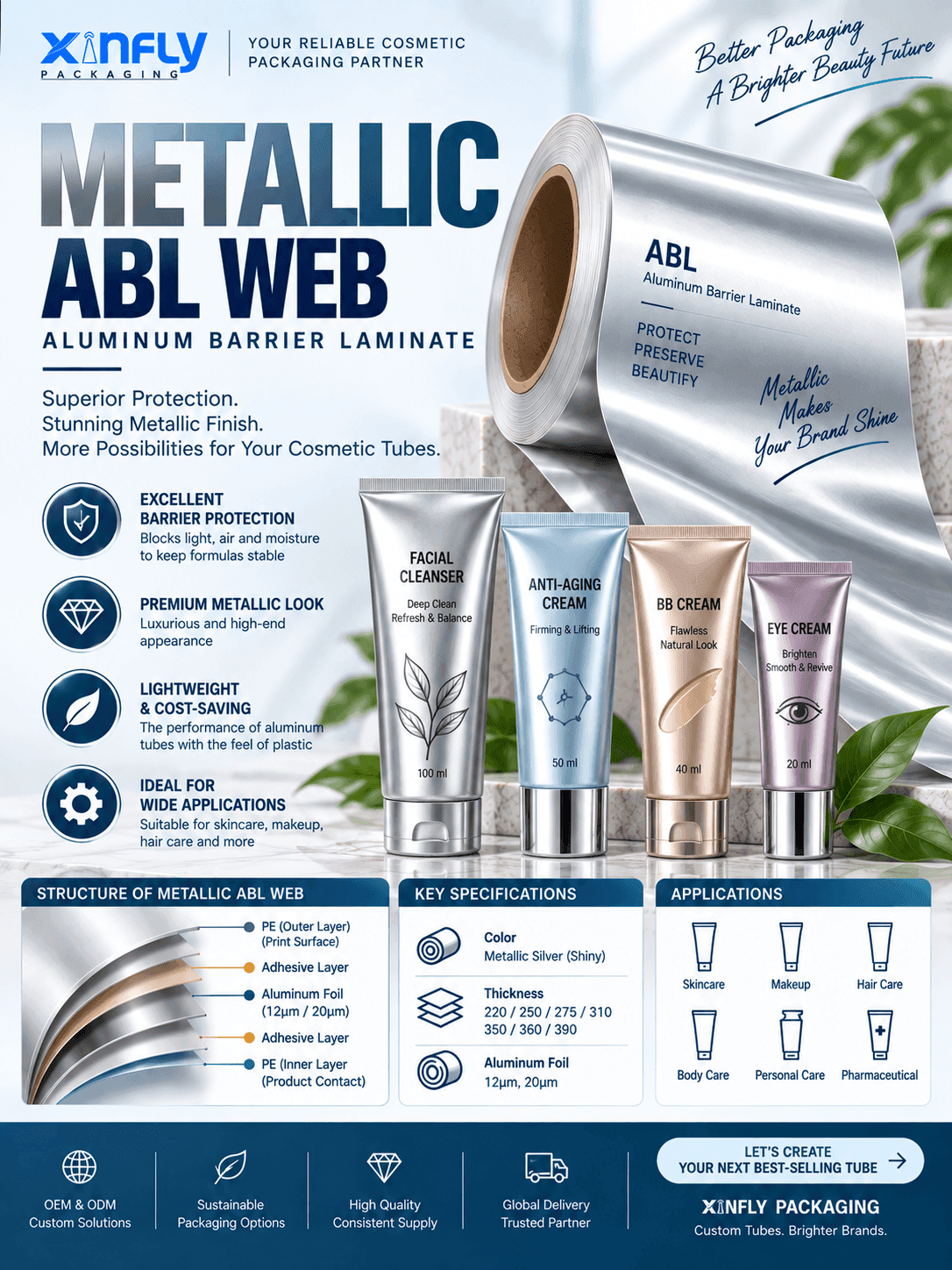
What Is Metallic Aluminum Barrier Laminate Web?
Metallic ABL is a multilayer laminate material designed for squeeze tube production. The aluminum foil layer provides strong protection against light, oxygen and moisture, while the metallic surface creates additional design possibilities for premium packaging.
Aluminum Foil Layer
The aluminum foil layer provides the primary light, gas and moisture barrier within the laminate structure.
Metallic Visual Effect
Visible metallic areas can become part of the artwork for premium, technical or luxury packaging.
Made for Laminate Tubes
The web can be printed and converted into flexible squeeze tube bodies for multiple applications.
Custom Printed ABL
Combine metallic substrate, white underprint, brand colors, graphics and decorative effects.
Typical Metallic ABL Structure
ABL is not simply a sheet of aluminum. It is a multilayer laminate combining polymer, bonding and aluminum barrier layers.
Metallic Aluminum Barrier Laminate Web Specifications
Select the laminate according to barrier requirements, tube diameter, capacity, squeeze feel, printing and finished-package performance.
| Parameter | Available Options | Procurement / Engineering Consideration |
|---|---|---|
| Material | Aluminum Barrier Laminate | Multilayer laminate containing aluminum foil. |
| Appearance | Metallic | Metallic substrate can be integrated into artwork. |
| Total Thickness | 220 / 250 / 275 / 310 / 350 / 360 / 390 μm | Do not select thickness only by price. Tube diameter, capacity and required stiffness matter. |
| Aluminum Foil | 12 μm / 20 μm | Foil thickness is separate from total laminate thickness. |
| Barrier Focus | Light / Oxygen / Moisture | Finished-package performance should be validated with the actual formulation. |
| Printing | Gravure / Flexo / Offset / Letterpress / Silk Screen / Hot Stamp | Printing route depends on artwork, substrate and conversion requirements. |
8 Common Metallic ABL Procurement Pain Points — and How Our Engineers Solve Them
Buying Metallic Aluminum Barrier Laminate Web is not only about comparing price per kilogram or total thickness. Small differences in laminate structure, foil, printing, bonding and conversion can become expensive problems after the material reaches tube production.
“The Sample Looks Metallic, but Bulk Production Looks Different.”
Metallic surfaces reflect light differently from white substrates. Ink opacity, substrate lot and printing conditions can change the perceived color and metallic effect.
Approve the Real Substrate, Not Only a Digital Color
Our engineers recommend physical printed proofing on the selected metallic ABL. Critical colors, white underprint and exposed metallic areas are confirmed before mass production.
“Should We Choose 12 μm or 20 μm Aluminum Foil?”
A thicker foil may sound safer, but selecting material only from foil thickness can increase cost or create unnecessary mechanical differences.
Evaluate the Complete Laminate Structure
We consider formula sensitivity, total laminate construction, tube diameter, capacity, squeeze characteristics and required package performance before recommending a structure.
“Which Total Thickness Should We Buy?”
220, 250, 275, 310, 350, 360 and 390 μm do not simply represent good-to-better grades. Too much stiffness can be as undesirable as too little.
Match Thickness to the Finished Tube
We evaluate tube diameter, length, filling volume, closure weight, required squeeze force and desired hand feel before selecting the laminate thickness.
“The Printed Colors Change on the Metallic Background.”
Pantone or CMYK colors can appear different when printed directly over a reflective metallic substrate.
Control White Underprint and Metallic Windows
Artwork is separated into opaque printed areas, white-underprinted areas and intentional metallic windows. Physical samples are recommended for critical brand colors.
“The Web Looks Fine, but Problems Appear After Tube Conversion.”
A laminate roll may pass visual inspection but still create issues during side-seam welding, heading, cutting or finished tube forming.
Validate Web-to-Tube Conversion
Xinfly evaluates the laminate as a tube-making material, not only as a printed roll. Side seam, body formation, heading and finished tube appearance are checked together.
“The Tube Creases or Keeps Visible Squeeze Marks.”
Aluminum-containing laminate behaves differently from conventional PE or PBL when repeatedly squeezed.
Balance Barrier with Mechanical Feel
Our engineers consider laminate thickness, tube diameter, shoulder design and intended dispensing behavior to reduce unnecessary stiffness and poor squeeze experience.
“We Need High Barrier, but Is ABL Compatible with Our Formula?”
High barrier alone does not prove that a package is compatible with a specific cream, gel, sunscreen, toothpaste or active formulation.
Run Formula-to-Package Compatibility Testing
We recommend testing the actual formula with the selected laminate, inner contact layer, closure and commercial filling conditions before final mass production.
“The First Order Works, but Repeat Orders Must Match.”
B2B buyers need repeatable thickness, printing, metallic appearance and tube conversion across production batches.
Lock Approved Production Standards
Approved material specifications, artwork, color references and key production parameters should become the reference standard for repeat orders.
From Formula to Finished Tube: Xinfly's Engineering Workflow
Instead of asking buyers to choose an ABL specification from a material list alone, our engineers work backward from the formula, finished tube and filling requirements.
Formula Review
Identify product type, viscosity, active ingredients and sensitivity to light, oxygen and moisture.
Barrier Definition
Determine whether aluminum barrier technology is appropriate for the packaging objective.
Laminate Selection
Evaluate total thickness, foil option, tube dimensions, stiffness and squeeze behavior.
Artwork Engineering
Define metallic exposure, white underprint, ink coverage and decoration requirements.
Tube Conversion
Evaluate side seam, tube-body formation, heading and closure compatibility.
Package Validation
Review filling, sealing, compatibility, appearance and transport requirements.
Don't Buy Metallic ABL by Price Alone
Two laminate quotations can look similar on paper while representing different structures, printing standards and conversion risks. Compare the complete technical package.
| Procurement Item | Common Buying Mistake | Better Purchasing Method |
|---|---|---|
| Total Thickness | Automatically selecting the thickest option. | Match thickness to tube mechanics and dimensions. |
| Aluminum Foil | Assuming 20 μm is always better than 12 μm. | Evaluate the complete approved laminate structure. |
| Metallic Color | Approving artwork only on a computer screen. | Approve a physical print on the actual substrate. |
| Printing | Comparing only number of colors. | Review ink opacity, white layer and metallic exposure. |
| Barrier | Evaluating only the raw laminate. | Validate the finished filled tube system. |
| Price | Comparing unit price without technical equivalence. | Compare structure, foil, printing, QC and conversion together. |
Typical Metallic ABL Engineering Scenario
A useful material recommendation starts with the customer's packaging problem rather than a predefined laminate thickness.
Premium High-Barrier Tube
Customer wants a metallic cosmetic tube with strong barrier performance and consistent premium appearance.
Color + Structure Conflict
Metallic substrate changes printed color appearance, while an unsuitable laminate thickness can affect squeeze feel and tube conversion.
Material + Print + Tube Validation
Select the ABL structure, define white underprint, approve a physical color proof and verify tube conversion before mass production.
Custom Printing for Metallic Aluminum Barrier Laminate Web
Printing should be developed together with the metallic substrate because the reflective background can become part of the final visual design.
Gravure Printing
Suitable for detailed, repeatable high-volume printed laminate projects.
Flexographic Printing
Available according to web structure and artwork requirements.
Offset Printing
Available for selected tube decoration and conversion routes.
Letterpress
Can be evaluated according to design and production requirements.
Silk Screen
Useful for strong spot colors, logos and selected decorative details.
Hot Stamping
Additional foil decoration can be incorporated where required.
Applications for Metallic ABL Web
Metallic ABL can be evaluated for products where barrier performance and metallic packaging appearance are both important.
Active Skincare
Retinol, vitamin-based and other selected sensitive skincare formulas.
Sunscreen
Opaque high-barrier packaging for selected sunscreen and sun-care products.
Toothpaste
ABL is widely used for toothpaste and oral-care tube packaging.
Premium Cosmetics
Metallic appearance for premium cosmetic and beauty packaging.
What Should Buyers Send for an Accurate ABL Quote?
The more technical information we receive, the easier it is to recommend an appropriate laminate rather than quote a generic material.
Metallic ABL RFQ Checklist
If you already use an ABL material, send the existing specification or sample together with the following information.
Explore Related Laminate Web Materials
Compare Metallic ABL with other laminate structures before finalizing your squeeze tube material.
Aluminum Barrier Laminate Web
ABL structures, thicknesses, foil options and applications.
Silver Laminate Web
Silver laminate material for metallic tube packaging applications.
Printed Laminated Web
Custom printed web for branded laminate tube production.
Metallic Aluminum Barrier Laminate Web FAQ
Technical and procurement questions from cosmetic tube and laminate web buyers.
1. What is Metallic Aluminum Barrier Laminate Web?
2. What thicknesses are available?
3. What aluminum foil thicknesses are available?
4. Is 20 μm aluminum foil always better than 12 μm?
5. Why do printed colors look different on Metallic ABL?
6. Can Metallic ABL be custom printed?
7. Can part of the metallic surface remain visible?
8. Is Metallic ABL the same as MPET laminate?
9. Can Metallic ABL be used for sunscreen tubes?
10. Can Metallic ABL be used for toothpaste?
11. Why should the laminate be tested after tube conversion?
12. What information should I provide for a quotation?
Need Help Selecting Metallic ABL Web?
Don't choose laminate thickness and aluminum foil from a specification table alone. Send Xinfly Packaging your formula, tube size, artwork, barrier requirements and quantity. Our factory engineering team can help evaluate the material, printing and tube-conversion solution.