

Laminate Tubes for Spot Treatment
Custom laminate tubes for spot treatments, blemish gels, targeted acne care, dark spot creams and concentrated facial skincare. Xinfly Packaging manufactures ABL, PBL and EVOH laminate tubes with small-volume formats, precision nozzles, controlled openings and customizable decoration.
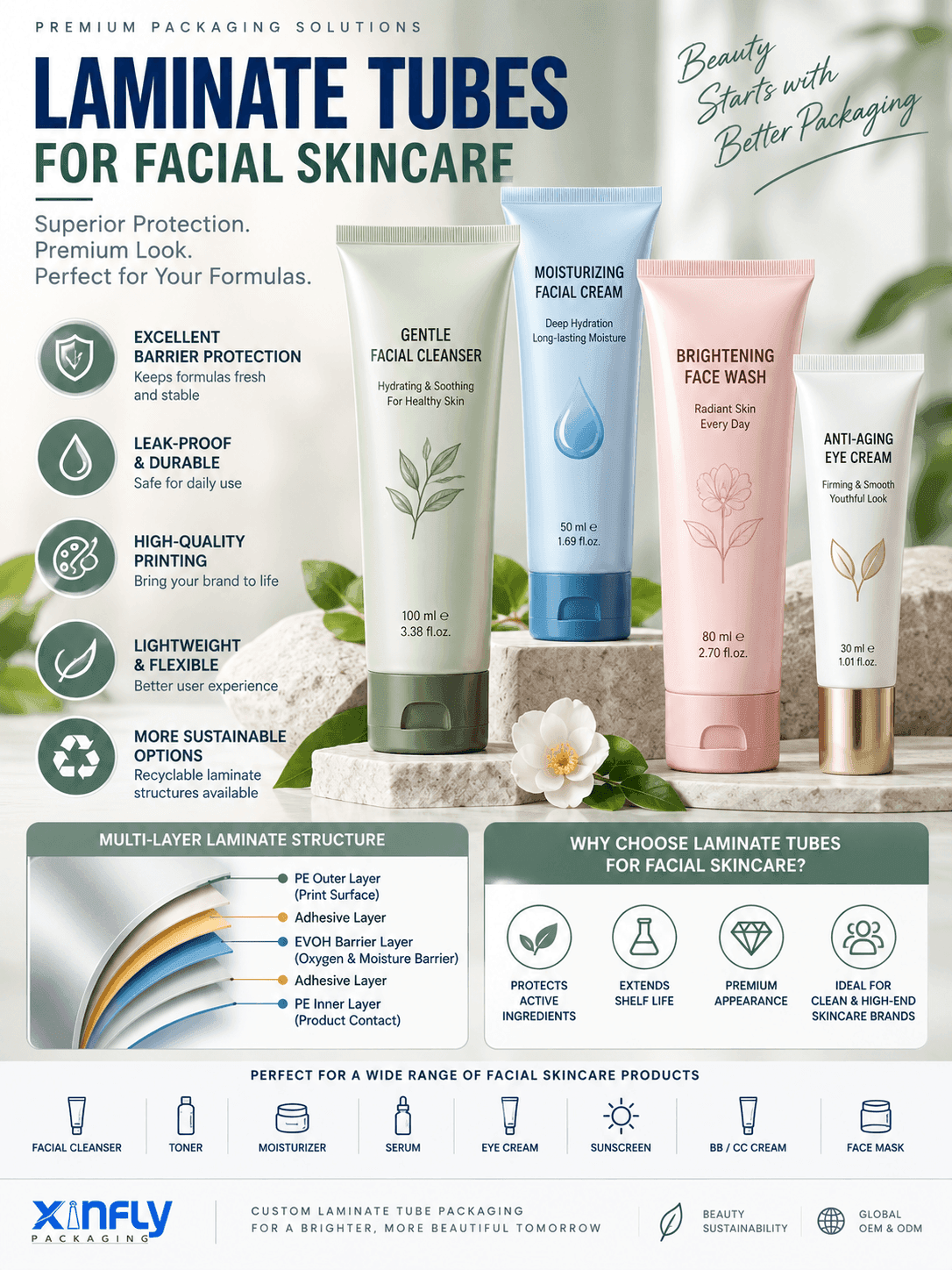
Precision Packaging for Targeted Spot Treatments
Spot treatments typically use small quantities per application. Packaging therefore needs to balance formula compatibility, controlled dosage, leakage resistance, opening size and convenient targeted dispensing.
Precision Application
Small openings and narrow nozzles help control product placement and dosage.
Small-Volume Formats
5–30 ml tubes are suitable for concentrated targeted skincare products.
Leakage Control
Closure fit and opening diameter are especially important for lightweight gels.
Formula-Based Barrier
ABL, PBL or EVOH can be selected according to the complete active system.
Spot Treatment Products Suitable for Laminate Tubes
Laminate tubes can support multiple targeted facial-care applications using precision dispensing formats.
Acne Spot Treatment
Small-dose targeted skincare packaging.
Blemish Gel
Controlled packaging for lightweight formulas.
Blemish Cream
Compact precision cream packaging.
Dark Spot Cream
Targeted tone-care packaging.
Post-Blemish Care
Small-volume facial treatment formats.
Targeted Niacinamide Gel
Multi-active precision skincare packaging.
Targeted Brightening Care
Precision dispensing for concentrated creams.
Travel Treatment
Portable concentrated facial skincare.
ABL vs PBL vs EVOH Tubes for Spot Treatment
Spot treatments can contain very different active systems. Material selection should be based on formula stability, required barrier, tube flexibility and dispensing design.
ABL Spot Treatment Tubes
Aluminum Barrier Laminate provides excellent oxygen and light protection where the finished formula requires stronger environmental barrier performance.
- Excellent oxygen barrier
- Excellent light barrier
- Strong multilayer construction
- Suitable for formula-specific high-barrier needs
PBL Spot Treatment Tubes
Plastic Barrier Laminate combines smooth cosmetic appearance, high-quality artwork and good squeeze recovery.
- Premium presentation
- Excellent printing quality
- Good squeeze recovery
- Suitable for retail skincare brands
EVOH Spot Treatment Tubes
EVOH multilayer tubes provide enhanced oxygen barrier performance while retaining flexible PE-based squeeze characteristics.
- Enhanced oxygen barrier
- Flexible squeeze feel
- Good shape recovery
- Suitable for compact treatment tubes
Spot Treatment Formula & Dispensing Guide
The best dispensing system depends heavily on viscosity and intended application quantity.
| Product Type | Typical Texture | Dispensing Focus | Recommended Test |
|---|---|---|---|
| Spot Treatment Gel | Low | Very small opening + secure closure | Leakage & dosage test |
| Blemish Gel-Cream | Low–Medium | Precision nozzle | Flow test |
| Spot Treatment Cream | Medium | Controlled opening | Dispensing test |
| Dark Spot Cream | Medium | Small-dose precision dispensing | Dosage test |
| Rich Targeted Treatment | Medium–High | Soft tube + adequate flow path | Squeeze-force test |
How to Choose Laminate Tubes for Spot Treatment
Precision treatment packaging should be engineered around formula behavior and target dosage.
Review the Formula
Identify all active ingredients, base ingredients and stability requirements.
Measure Viscosity
Determine whether the product is a gel, gel-cream or standard treatment cream.
Define Target Dosage
Decide how much product the consumer should typically dispense per use.
Select Barrier Structure
Compare ABL, PBL and EVOH according to actual formula requirements.
Select Nozzle & Opening
Match opening diameter to formula flow and target application.
Validate Filled Samples
Test leakage, dosage, compatibility, closure performance and sealing.
Spot Treatment Tube Sizes & Orifice Guide
Compact 5–20 ml tubes are especially suitable for concentrated targeted applications.
| Capacity | Typical Application | Suggested Diameter | Orifice Starting Point |
|---|---|---|---|
| 5 ml | Concentrated Spot Treatment | Φ16 mm | Approx. 1 mm |
| 10 ml | Acne / Blemish Gel | Φ16–19 mm | Approx. 1–1.5 mm |
| 15 ml | Spot Treatment Cream | Φ19–22 mm | Approx. 1–1.5 mm |
| 20 ml | Dark Spot / Blemish Treatment | Φ22–25 mm | Approx. 1.5–2 mm |
| 30 ml | Broader Targeted Facial Treatment | Φ25–30 mm | Approx. 1.5–2.5 mm |
Precision Dispensing Options for Spot Treatment Tubes
The closure and nozzle system should control flow without making the product difficult to dispense.
Long Precision Nozzle
Suitable for small-area applications and concentrated treatments where controlled product placement is important.
- Targeted dispensing
- Small-dose application
- Suitable for 5–20 ml tubes
Small Standard Orifice
Useful for cream or gel-cream products where direct targeted use is required without an extended nozzle.
- Simple design
- Controlled dosage
- Multiple cap options
Secure Screw Closure
Screw closures are useful where a low-viscosity formula requires secure transport and storage performance.
- Secure closure
- Suitable for travel sizes
- Closure cycling can be validated
Engineer Recommendations for Spot Treatment Tubes
For targeted skincare, dispensing accuracy and leakage control can be more important than simply choosing the highest available barrier structure.
Ask an EngineerSpot products are used in small quantities, so opening size strongly affects the user experience.
A small difference in opening diameter can significantly affect unwanted flow and leakage.
Oversized openings can make concentrated treatment products difficult to control.
Compact treatment tubes are often opened frequently, so repeated closure performance should be checked.
Barrier requirements should be based on the entire finished formula rather than the term “spot treatment.”
Final testing should include tube, nozzle, closure, tail seal and the commercial formulation.
Spot Treatment Packaging Validation
Small-volume treatment packaging should be tested for both formula compatibility and dispensing consistency.
Compatibility
Evaluate interaction between formula and packaging materials.
Dosage Test
Measure product output during typical consumer squeezing.
Leakage Test
Confirm nozzle, closure and tail-seal performance.
Closure Cycling
Evaluate repeated opening and closing.
Storage Test
Evaluate filled-package behavior under suitable conditions.
Filling-Line Trial
Validate filling, eye mark and tail sealing.
Custom Spot Treatment Tube Specifications
Xinfly Packaging can customize small laminate tubes for targeted skincare with different capacities, barrier structures, nozzle designs, openings and decoration.
For best results, provide formula viscosity, target dosage and intended application method when requesting a packaging recommendation.
Request Technical SupportWhy Choose Xinfly Packaging for Spot Treatment Tubes
Custom small-volume laminate tube manufacturing for acne, blemish, dark spot and targeted facial skincare.
5–30 ml Tube Options
Compact formats for concentrated skincare treatments.
Precision Nozzles
Targeted product placement and controlled dispensing.
ABL, PBL & EVOH
Multiple barrier structures for different formulas.
Leakage Control
Support for gel and lower-viscosity treatment products.
Premium Decoration
Matte, soft touch, CMYK, silk screen and hot stamping.
OEM & ODM Support
Support for brands, private labels and contract fillers.
Explore Related Targeted Skincare Packaging
Connect spot-treatment packaging with acne care, niacinamide and brightening skincare pages.
Acne Treatment Cream Tubes
Explore custom laminate packaging for acne creams, blemish gels and oil-control facial skincare.
View Acne Treatment Tubes
Niacinamide Cream Tubes
Explore laminate tubes for niacinamide creams and multi-active facial products.
View Niacinamide Tubes
Brightening Cream Tubes
Explore laminate packaging for brightening creams, tone-care and targeted facial skincare.
View Brightening Tubes
Spot Treatment Laminate Tube FAQ
Common sourcing questions about small laminate tubes for targeted facial skincare.
Are laminate tubes suitable for spot treatments?
What tube size is best for spot treatment?
Can spot treatment tubes use precision nozzles?
What orifice size is suitable for spot treatment?
Are laminate tubes suitable for low-viscosity spot gels?
Which material is best for a spot treatment tube?
Can spot treatment tubes use screw caps?
Can spot treatment tubes be made in opaque colors?
Can spot treatment tubes have matte or soft-touch finishes?
Should the final spot treatment formula be tested in the tube?
What is the MOQ for custom spot treatment tubes?
Can Xinfly provide spot treatment tube samples?
Develop Your Custom Spot Treatment Tube
Send Xinfly Packaging your treatment type, formula viscosity, target dosage, capacity, preferred ABL, PBL or EVOH structure, nozzle design, opening diameter, closure, artwork and estimated quantity. Our team can help evaluate a suitable small laminate tube for your targeted skincare project.