

How to Choose Shampoo & Conditioner Tubes for Retail and Hotel Amenities
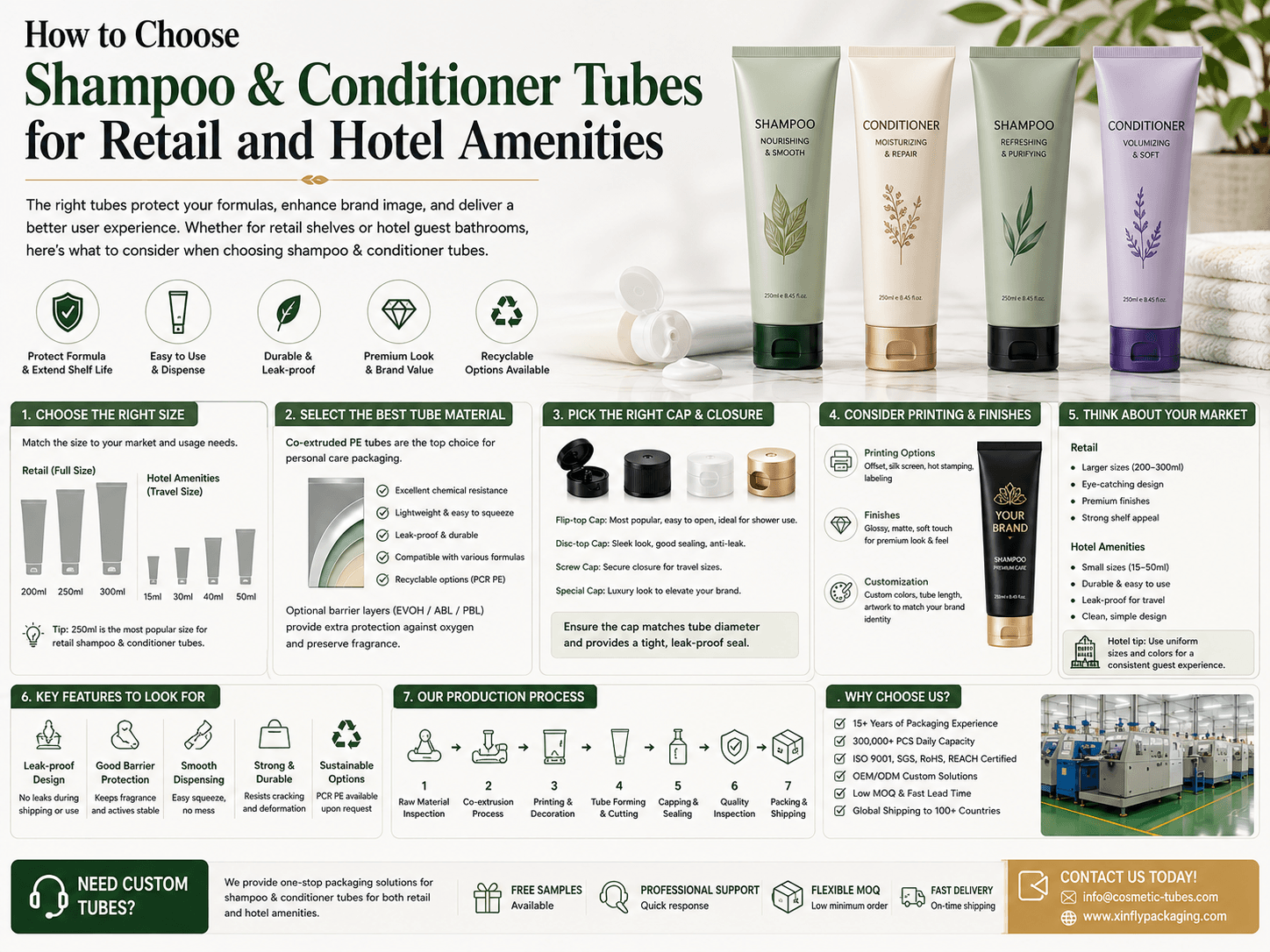
Shampoo and conditioner tubes must perform well in wet bathrooms, hotel rooms, travel kits, retail shelves and e-commerce shipping. The right tube should squeeze smoothly, resist leakage, protect fragrance, match your brand image and support efficient filling. This guide helps personal care and hotel amenity brands choose the right shampoo tube and conditioner tube packaging before sampling and mass production.
Common Purchasing Pain Points for Shampoo and Conditioner Tubes
Shampoo and conditioner packaging looks simple, but the real problems often appear in hotel bathrooms, retail transport, wet-hand use and repeated squeezing.
Cap leakage after repeated opening
Shampoo and conditioner tubes are used with wet hands. Weak flip-top hinges, poor cap sealing or wrong orifice size can cause leakage and messy bathroom storage.
Conditioner is harder to squeeze than shampoo
Shampoo is usually more fluid, while conditioner can be thicker and creamier. Tube softness, diameter and opening size should match each formula.
Small tubes need cost and MOQ control
Hotel amenity tubes require stable quality, clean appearance, fast delivery and controlled cost, especially for 10ml, 20ml, 30ml and 50ml sizes.
Large tubes need stronger brand impact
Retail shampoo and conditioner tubes need bigger front panels, durable printing and consistent family-style design across product lines.
Fragrance may fade during storage
Fragrance-rich hair care formulas may require better material compatibility or barrier support to reduce aroma loss and odor change.
Tube deformation during export cartons
Large retail tubes may deform if wall thickness, carton layout or cap protection is not properly designed for long-distance shipment.
Choose Shampoo & Conditioner Tube Structure Based on Application
Retail hair care tubes and hotel amenity tubes have different priorities. Retail tubes need shelf impact and strong user experience, while hotel tubes need cost efficiency, compact size and stable mass supply.
| Application Type | Main Packaging Risk | Recommended Tube Structure | Factory Engineer’s Suggestion |
|---|---|---|---|
| Hotel shampoo tubes 10ml–50ml amenities | Cost control, leakage, fast production, clean appearance | Soft PE tube with screw cap or small flip-top cap | Use standard diameter and cap to improve production efficiency and reduce unit cost. |
| Hotel conditioner tubes | Thicker formula, difficult squeezing, small opening blockage | Soft PE tube with suitable orifice size | Use slightly larger orifice than shampoo when conditioner viscosity is higher. |
| Retail shampoo tubes 100ml–250ml | Wet-hand use, shelf appeal, transport leakage | 2-layer PE tube or multi-layer PE tube with flip-top cap | Choose Ø40mm–Ø50mm diameter and strong flip-top cap for daily bathroom use. |
| Retail conditioner tubes | High viscosity, squeeze force, tube recovery | Soft PE tube with larger opening flip-top cap | Test squeeze force and cap dispensing before confirming mass production. |
| Premium hair care products | Fragrance retention, brand value, finish durability | PE, EVOH PE, ABL or PBL tube | Use barrier structure when fragrance, actives or long shelf-life protection is important. |
Factory Engineer + Packaging Designer Solutions
A good shampoo or conditioner tube should be easy to use in a wet bathroom, safe during transport, efficient for filling and attractive for retail or hotel brand presentation.
Engineer’s Solution for Hair Care Tubes
From a production engineering view, shampoo and conditioner tube selection should focus on formula viscosity, cap sealing, wall thickness, filling speed and transportation safety.
- Use soft PE tubes for most shampoo, conditioner and body wash formulas.
- Use larger orifice caps for thick conditioner or mask-like formulas.
- Use flip-top caps for retail bathroom use and screw caps for small hotel amenity tubes.
- Use barrier structures when fragrance retention or active ingredient protection is important.
- Run leakage, drop, compression, cap torque, heat storage and filling tests before bulk production.
Designer’s Solution for Retail and Hotel Presentation
Shampoo and conditioner tubes usually appear as a set. The design should make each product easy to distinguish while keeping a consistent brand family.
- For hotel amenities: clean minimalist design, clear product name and consistent color system across shampoo, conditioner, shower gel and lotion.
- For retail shampoo: large front benefit, strong color block and clear hair type positioning.
- For premium conditioner: pearlized finish, soft-touch effect or metallic hot stamping.
- For natural hair care: matte or glossy tube with botanical colors and recyclable message.
- For e-commerce: high-contrast front label, readable product name and scratch-resistant varnish.
How to Choose Shampoo & Conditioner Tube Capacity, Diameter and Cap
Capacity and diameter should match the sales channel. Hotel amenities focus on compact volume and cost control, while retail products focus on shelf impact, comfort and bathroom usability.
| Product Positioning | Common Capacity | Suggested Diameter | Recommended Cap | Best For |
|---|---|---|---|---|
| Hotel amenity mini tubes | 10ml, 15ml, 20ml, 30ml | Ø16mm – Ø25mm | Small screw cap | Hotel rooms, airline kits, travel sets, promotional samples |
| Travel hair care tubes | 30ml, 50ml, 60ml, 80ml | Ø25mm – Ø35mm | Screw cap or small flip-top cap | Travel retail, gift sets, trial kits, private label hair care |
| Retail shampoo tubes | 100ml, 150ml, 200ml | Ø40mm – Ø50mm | Flip-top cap | Daily shampoo, scalp care, family hair care, personal care brands |
| Retail conditioner tubes | 150ml, 200ml, 250ml | Ø45mm – Ø50mm | Large flip-top cap | Conditioner, hair mask, repair treatment, thicker hair care formulas |
| Professional salon tubes | 200ml, 250ml, 300ml | Ø50mm – Ø60mm | Large flip-top cap or pump structure | Salon hair care, professional treatment, spa and premium hotel lines |
Quick Recommendation: Which Tube Material Is Best for Shampoo and Conditioner?
The best hair care tube material depends on formula viscosity, fragrance level, product size, target market and sustainability requirements.
You need flexible daily-use packaging
PE tubes are suitable for most shampoo and conditioner formulas because they provide good squeeze feel, flexible printing options, stable production and cost efficiency.
You need fragrance or active protection
EVOH, ABL or PBL tubes can be considered when hair care formulas contain fragrance, essential oils, active ingredients or long shelf-life requirements.
You need an eco-friendly brand story
PCR PE and sugarcane PE tubes are suitable for sustainable hotel amenities and clean hair care brands, but odor, color and compatibility should be tested first.
6-Step Process to Choose Shampoo & Conditioner Tubes
This process helps brands avoid wrong size, weak cap sealing, poor squeeze performance and inconsistent design across product lines.
Check Formula
Confirm shampoo or conditioner viscosity, fragrance, oil content, filling temperature and shelf-life target.
Define Channel
Choose retail, hotel amenity, travel kit, salon, e-commerce or private label positioning.
Select Size
Match 10ml–50ml for hotel use or 100ml–300ml for retail and professional hair care.
Choose Cap
Use screw caps for mini tubes and flip-top caps for retail bathroom-use tubes.
Confirm Artwork
Prepare AI/PDF files, product name differences, color system, printing method and finish.
Test Samples
Run leakage, squeeze force, drop, heat storage, compatibility and printing adhesion tests.
Mass Production
Xinfly controls tube extrusion, printing, cap matching, inspection and export packing.
Final Inspection
Check tube size, wall thickness, cap fit, printing quality, sealing area and carton protection.
Build Your How to Choose Packaging Knowledge Cluster
Continue reading related Xinfly guides to compare hair care tubes, hotel amenity packaging, PE squeeze tubes, surface finishes and private label customization options.
FAQ: Choosing Shampoo & Conditioner Tubes
These questions help personal care and hotel amenity brands quickly confirm size, material, cap, finish and testing before requesting samples.
What material is best for shampoo and conditioner tubes?
Soft PE tubes are the most common choice for shampoo and conditioner packaging because they provide good squeeze feel, flexible decoration and stable production. For fragrance-rich or active formulas, EVOH, ABL or PBL barrier tubes can be considered.
What size is common for hotel shampoo tubes?
10ml, 15ml, 20ml, 30ml and 50ml are common hotel shampoo tube sizes. Small screw caps are often used because they are simple, cost-effective and suitable for amenity programs.
What size is common for retail shampoo and conditioner tubes?
100ml, 150ml, 200ml and 250ml are common retail sizes. Ø40mm to Ø50mm diameter tubes are practical for bathroom use, shelf display and comfortable squeezing.
Should shampoo tubes use screw caps or flip-top caps?
Screw caps are suitable for small hotel amenity tubes and travel kits, while flip-top caps are better for larger retail shampoo and conditioner tubes used in bathrooms.
Can PCR material be used for shampoo and conditioner tubes?
Yes, PCR PE can be used for shampoo and conditioner tubes, especially for sustainable hotel amenities and clean personal care brands. Color, odor, strength and formula compatibility should be tested before production.
How do I prevent shampoo tube leakage?
Leakage prevention depends on cap fit, orifice size, shoulder design, tail sealing strength, filling process and formula viscosity. Xinfly recommends leakage, drop, heat storage and cap sealing tests before bulk production.
Need Help Choosing Shampoo & Conditioner Tubes?
Share your shampoo or conditioner formula, target capacity, retail or hotel use scenario, cap preference, artwork style and expected order quantity. Xinfly Packaging can recommend suitable PE, PCR, EVOH, ABL, PBL or hotel amenity tube solutions with engineering and artwork support.