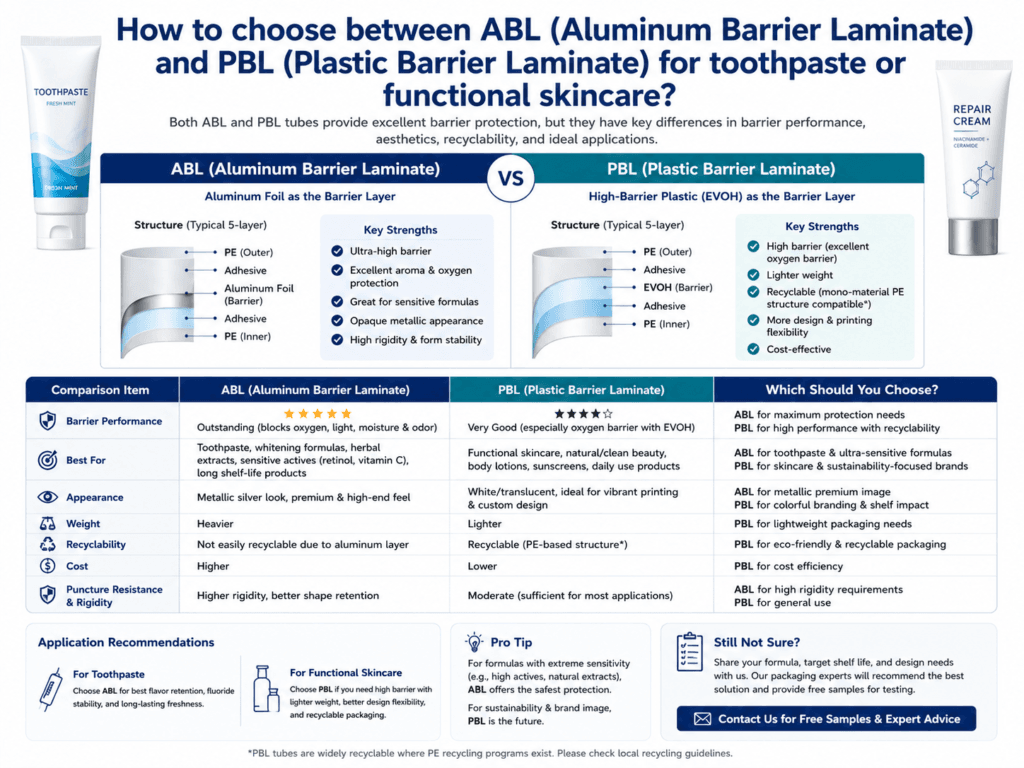
To choose between ABL (Aluminum Barrier Laminate) and PBL (Plastic Barrier Laminate) tubes for toothpaste or functional skincare, brands should compare barrier requirement, product sensitivity, squeeze recovery, appearance, recyclability positioning, and cost. In simple terms, ABL is usually better when maximum barrier protection is the priority, while PBL is often better when the brand wants a cleaner cosmetic look, better tube recovery, and a more plastic-based sustainability direction.
For toothpaste, ABL tubes are widely used because toothpaste formulas often need strong protection against oxygen, moisture, flavor loss, and long storage periods. For functional skincare, the choice is more formula-dependent. ABL may be suitable for very sensitive or aggressive formulations, while PBL is often preferred for premium skincare products that need good barrier performance and a smoother cosmetic appearance.
Quick Comparison: ABL vs. PBL Tubes
| Item | ABL Tube | PBL Tube |
|---|---|---|
| Full name | Aluminum Barrier Laminate | Plastic Barrier Laminate |
| Barrier layer | Aluminum foil layer | Plastic barrier layer, commonly EVOH-based |
| Barrier strength | Very high, especially against oxygen, moisture, light, and aroma loss | Good to high, especially for oxygen and aroma protection depending on structure |
| Squeeze recovery | More collapsible; may hold the squeezed shape | Better recovery; usually returns closer to original shape |
| Appearance | Functional, protective, traditional toothpaste feel | Cleaner, more cosmetic and premium-looking |
| Sustainability positioning | More difficult because aluminum and plastic are combined | Often easier to position as plastic-based barrier packaging |
When Should You Choose ABL Tubes?
Choose ABL tubes when the formula needs the strongest barrier protection and long shelf-life performance. The aluminum layer helps block oxygen, moisture, light, and flavor or fragrance loss. This makes ABL a strong choice for toothpaste, medicated paste, ointment-like products, aggressive formulas, and functional formulas where protection matters more than squeeze recovery or recyclability positioning.
- Best for toothpaste: Especially fluoride toothpaste, whitening toothpaste, herbal toothpaste, and functional oral care formulas.
- Best for high-barrier needs: Suitable when oxygen, moisture, light, or aroma loss is a major concern.
- Best for long shelf life: Useful for products requiring strong storage protection.
- Best for collapsible dispensing: ABL can hold its squeezed shape more than PBL.
When Should You Choose PBL Tubes?
Choose PBL tubes when you want good barrier protection with a more flexible, plastic-based, cosmetic-style package. PBL tubes usually recover better after squeezing, giving the tube a cleaner appearance throughout consumer use. This can be important for functional skincare, premium sunscreen, facial treatment cream, and other products where shelf appearance and user experience matter.
- Best for premium skincare: Cleaner appearance and better squeeze recovery make PBL more cosmetic-friendly.
- Best for plastic-based sustainability positioning: PBL avoids the aluminum-plastic mixed barrier structure of ABL.
- Best for products needing good but not extreme barrier: Suitable for many functional skincare, sunscreen, and personal care formulas.
- Best for better shelf appearance after use: PBL tubes usually look less creased than ABL after repeated squeezing.
Which Is Better for Toothpaste?
| Toothpaste Type | Recommended Tube | Reason |
|---|---|---|
| Standard toothpaste | ABL or PBL | Both can work; ABL is traditional, PBL is cleaner-looking |
| Whitening toothpaste | ABL | Often benefits from stronger barrier protection |
| Fluoride toothpaste | ABL | Strong barrier and long shelf-life protection are important |
| Natural / eco-positioned toothpaste | PBL | Better choice when brand wants plastic-based sustainability messaging |
| Premium oral care | PBL or ABL | PBL for appearance; ABL for maximum protection |
Which Is Better for Functional Skincare?
| Skincare Formula | Recommended Tube | Reason |
|---|---|---|
| Basic cream or cleanser | PBL or PE tube | Extreme aluminum barrier may not be necessary |
| Retinol / active treatment cream | PBL or ABL depending on sensitivity | Barrier protection is important; appearance may also matter |
| Oil-rich functional skincare | PBL or ABL | Choice depends on oxygen, aroma, and migration sensitivity |
| Highly sensitive or light-sensitive formula | ABL | Aluminum layer provides stronger light and barrier protection |
| Premium cosmetic skincare | PBL | Better tube recovery and smoother cosmetic appearance |
Main Advantages of ABL Tubes
- Excellent barrier performance: Strong protection against oxygen, moisture, light, and aroma loss.
- Strong shelf-life support: Suitable for toothpaste and functional paste products.
- Good protection for aggressive formulas: Useful for formulas that may challenge simpler plastic tubes.
- Traditional toothpaste packaging feel: Familiar to many oral-care markets.
Main Limitations of ABL Tubes
- Less squeeze recovery: The tube may keep creases after use.
- More difficult recyclability positioning: Aluminum and plastic laminate layers are harder to separate.
- Less “clean cosmetic” appearance after repeated use: It may look more collapsed than PBL over time.
Main Advantages of PBL Tubes
- Better squeeze recovery: The tube often returns closer to its original shape after use.
- Cleaner appearance: Good for premium cosmetic and skincare packaging.
- Good barrier performance: EVOH or other plastic barrier structures can protect many functional formulas.
- Better sustainability positioning than ABL in many projects: Plastic-based laminate structures are often easier to discuss for recycling strategy than aluminum-plastic laminates.
Main Limitations of PBL Tubes
- Barrier may be lower than ABL: Especially when light, moisture, or extreme barrier protection is required.
- May cost more depending on structure and decoration: Premium PBL structures can be more expensive than basic ABL options.
- Not always ideal for aggressive formulas: Formula compatibility still needs testing.
Decision Guide: ABL or PBL?
| If Your Priority Is… | Choose | Why |
|---|---|---|
| Maximum barrier protection | ABL | Aluminum foil provides very strong protection |
| Traditional toothpaste packaging | ABL | Widely used and proven for toothpaste |
| Clean cosmetic appearance | PBL | Better recovery and smoother look after squeezing |
| Sustainability-focused skincare positioning | PBL | Plastic-based barrier structure is usually easier to position than aluminum-plastic laminate |
| Light-sensitive or highly aggressive formula | ABL | Stronger light and barrier protection |
| Premium functional skincare | PBL | Good balance of barrier, appearance, and user experience |
Best Practical Recommendation
For toothpaste, start with ABL if the priority is maximum protection, long shelf life, and traditional oral-care performance. Consider PBL if the brand wants a more premium, cleaner-looking, or sustainability-positioned toothpaste tube.
For functional skincare, start with PBL when appearance, squeeze recovery, and plastic-based sustainability messaging are important. Choose ABL when the formula is highly sensitive to oxygen, moisture, light, fragrance loss, or ingredient migration, and barrier protection is more important than tube recovery.
Summary
ABL and PBL are both strong laminate tube options, but they serve different priorities. ABL is usually the better choice for toothpaste and highly sensitive formulas that need maximum barrier protection. PBL is often the better choice for functional skincare and premium cosmetic packaging where appearance, squeeze recovery, and sustainability positioning matter more.
The safest choice should be based on formula sensitivity, target shelf life, barrier requirement, appearance preference, recyclability goals, and real compatibility testing.
Learn more: ABL vs PBL Tubes, ABL Tubes, PBL Tubes, Laminate Tubes, Toothpaste Tube Manufacturer, Custom Toothpaste Tube Packaging.
Need Help Choosing ABL or PBL Tubes?
Xinfly Packaging helps toothpaste and functional skincare brands compare ABL, PBL, EVOH, and other barrier tube structures based on formula sensitivity, shelf-life goals, appearance, cost, and sustainability positioning.