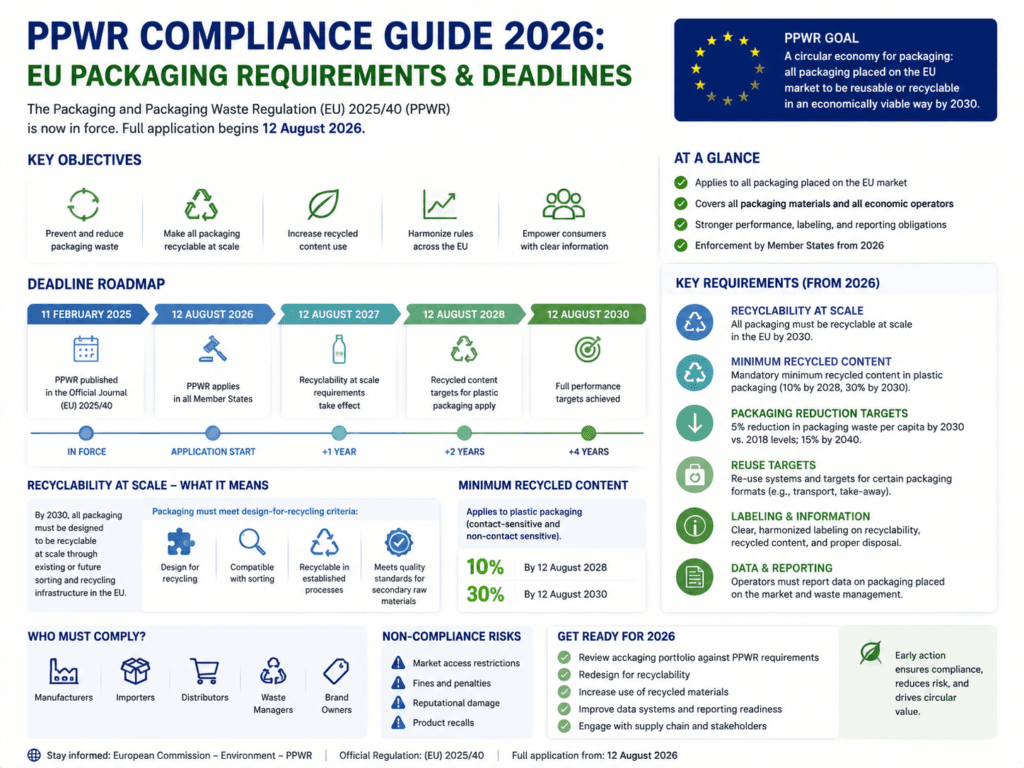
You must follow strict packaging waste rules in the EU by 2026. The packaging and packaging waste regulation affects all packaging sold in the EU. The regulation includes rules about substance limits, PFAS bans, standards, labeling, recyclability, recycled content, packaging reduction, format bans, registration, and conformity checks. Getting ready early keeps your business safe from fines and helps you follow the rules. Look at the table below for important deadlines:
| Requirement/Deadline | Description |
|---|---|
| Substance restrictions | New heavy metal limits start in August 2026. |
| PFAS ban | PFAS banned above limits in August 2026. |
| Registration | Sign up in producer registers by August 12, 2026. |
| Conformity assessments | Needed for all packaging by August 12, 2026. |
Not following packaging waste rules can lead to fines and losing market access. The european packaging regulation changes the packaging waste directive and sets new packaging standards.
Key Takeaways
- Remember the important dates: All packaging must follow new EU rules by August 12, 2026.
- Make sure packaging can be recycled: By 2030, all packaging must be recyclable or reusable to meet EU standards.
- Keep learning: Check for new rules and advice from the European Commission often.
- Write everything down: Save clear records of your packaging types and compliance for five to ten years.
- Start soon: Begin getting ready now so you do not get fined and your products can stay in the EU market.
Key Changes in Packaging and Packaging Waste Regulation
Scope and Application Dates
You need to know what the packaging waste regulation covers. It includes all packaging sold in the EU. This means sales packaging, grouped packaging, and transport packaging. You see these as product boxes, bundle wraps, and shipping cartons. The regulation affects many areas like industry, retail, services, e-commerce, and homes. Both business and consumer packaging are included. All materials are part of the regulation, like plastics, paper, cardboard, metals, glass, wood, and composite packaging. EU manufacturers and importers must follow these rules. The regulation starts on August 12, 2026. On this day, you must follow PFAS bans, heavy metal limits, declaration rules, and extended producer responsibility.
Note: The packaging waste regulation covers every kind of packaging and packaging waste entering the EU market.
Main Regulatory Requirements
The packaging waste regulation brings stricter rules. You must follow limits for PFAS and heavy metals. All packaging must be recyclable. Plastic packaging needs recycled materials. There are limits on packaging weight, size, and materials to cut waste. You must use clear labels to show what materials are used and how to dispose of them. Extended producer responsibility means you pay for the waste your packaging makes. Fees depend on how recyclable your packaging is and its design. You must register and provide conformity checks for all packaging.
| Requirement | Description |
|---|---|
| Recyclability | All packaging must be recyclable according to EU standards. |
| Minimum Recycled Content | Plastic packaging must contain recycled materials, with thresholds increasing over time. |
| Packaging Reduction | Limits on excessive packaging to reduce waste. |
| Standardized Labeling | Clear labels for material and disposal information. |
| Extended Producer Responsibility | Producers pay fees based on packaging design and recyclability. |
Recyclability and Reuse Targets
The packaging waste regulation sets big goals. By 2030, all packaging must be recyclable or reusable. At least 40% of transport packaging must be reusable each year. At least 10% of grouped packaging that is not cardboard must be reusable. Packaging will get a recyclability grade. Only grades C or higher will be allowed from 2030. By 2038, only grades A and B will be allowed. You must design packaging so it can be recycled and use recycled materials to meet these goals. The regulation wants to cut waste and help make packaging more recyclable everywhere.
- All packaging must be recyclable or reusable by 2030.
- Transport packaging: 40% must be reusable.
- Grouped packaging: 10% must be reusable.
- Packaging gets a recyclability grade (A, B, C, D).
- Only grades C or higher allowed from 2030.
2026 Compliance Deadlines and Timeline
Key Dates for Businesses
You need to remember important dates for the packaging waste regulation. The rules start on August 12, 2026. On this day, all packaging must follow new rules in the EU. You must meet limits for heavy metals and PFAS. You have to register for extended producer responsibility. You must give a declaration of conformity for each packaging type. The regulation also needs clear labels and identification for makers and importers. The timeline has many steps:
| Date | Requirement |
|---|---|
| August 12, 2026 | All packaging must follow the regulation. |
| August 2026 | Heavy metal limits and PFAS ban begin. |
| December 2026 | Start making recycled content methods. |
| February 2027 | Begin using harmonised standards for packaging minimisation. |
| February 2028 | Composability standards for some items are required. |
| August 2028 | Harmonised material label needed on all packaging. |
| February 2029 | Labels needed for reusable packaging. |
| January 1, 2030 | All packaging must be recyclable and meet grades. |
Tip: You should get ready for each deadline. More rules will come until 2040.
Transition and Grace Periods
You have 18 months to get ready for the packaging waste regulation. This time ends in August 2026. You must update packaging, register, and check conformity before this date. The regulation does not give extra time for new packaging after August 12, 2026. Old stock in the supply chain can be sold, but rules are different in each country. You must check local rules to avoid mistakes.
- Transition period lasts 18 months and ends August 2026.
- No extra time for new packaging after the deadline.
- Rules for old stock depend on each EU country.
Penalties for Non-Compliance
If you do not follow the packaging waste regulation, you can get strict penalties. Authorities can take and destroy packaging that does not follow the rules. You may lose access to EU markets. Fines can be €500,000 or more for each mistake. Packaging without a valid declaration can be stopped from entering the EU. Teams can remove packaging from shelves. Public reports of violations can hurt your reputation.
| Type of Penalty | Description |
|---|---|
| Product seizure | Packaging that does not follow rules can be destroyed. |
| Market bans | Brands can lose access to EU markets. |
| Fines | Up to a percentage of yearly sales or €500,000+ for each mistake. |
| Reputational damage | Public reports of not following rules. |
Note: You must follow the regulation to keep your business safe from fines, bans, and harm to your reputation.
Achieving Compliance with Packaging Waste Regulation
Assessing Current Packaging
You should first look closely at your packaging. The packaging waste regulation wants you to know every kind you use. Start by making a list of all your packaging. Write down each type, like boxes, tubes, and cartons. Put them into groups by what they are made of and what they do. Ask your suppliers for technical papers. These papers tell you what is in your packaging and if it can be recycled. Check each packaging type to see if it follows the rules. Make a Declaration of Conformity to show your packaging is okay. Get ready for new rules, like digital labels and QR codes, which are coming soon.
Here is an easy checklist you can use:
- List all your packaging by type and material.
- Get documents from suppliers for each packaging.
- Check if your packaging follows the rules and make Declarations of Conformity.
- Get ready for new things like digital labels and QR codes.
You can use tools like Coolset, Recyda, Valpack, Packa, PPWR Copilot, and Trace One. These tools help you keep track of packaging data, get documents from suppliers, check if packaging can be recycled, and help with reporting.
Choosing Compliant Solutions
You need to pick packaging that follows the packaging waste regulation. Choose packaging made with recycled materials and without banned things. Make sure your packaging is easy to recycle and does not have too much empty space. The regulation gives clear rules for packaging that is allowed:
| Criteria | Description |
|---|---|
| Packaging minimization | Keep empty space in packaging under 40% to cut waste. |
| Recyclability performance grades | Use packaging that gets at least grade C for recyclability by 2030. |
| Reuse targets for transport packaging | Make sure 10% of transport packaging can be used again by 2030. |
| Labelling and QR code requirements | Add labels and QR codes to show what the packaging is made of and if it can be recycled. |
| Substances of concern restrictions | Do not use PFAS and heavy metals, which are not allowed by the regulation. |
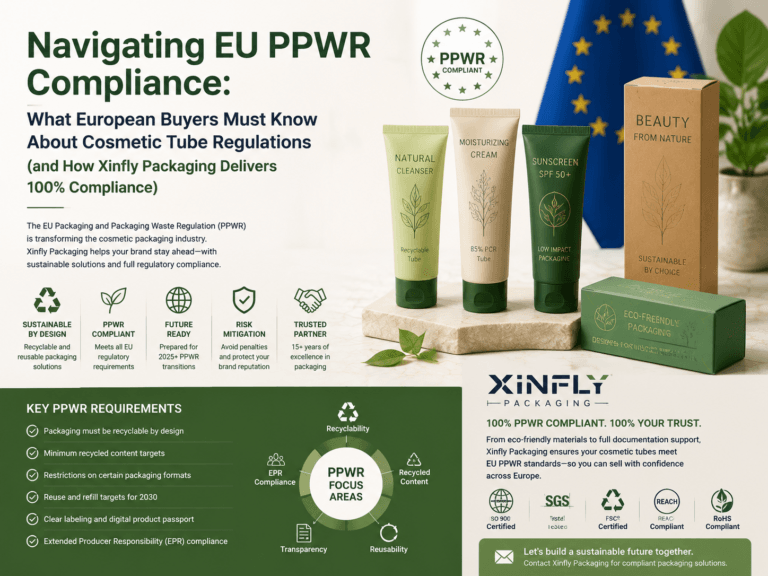
You can work with suppliers who already follow these rules. For example, Xinfly Packaging sells cosmetic tubes with a PPWR certificate. This means their packaging follows the regulation and helps you follow the rules faster. Picking certified suppliers helps cut packaging waste and supports recycling.
Documentation and Reporting
The packaging waste regulation says you must keep good records for every packaging type. You need a technical file that shows your packaging follows all the rules. This file should have packaging details, what it is made of, and proof it can be recycled. Keep other papers to show you are following the rules.
You also need to make a Declaration of Conformity for each packaging. This paper should have:
- What the packaging is (SKU, material, size)
- The recyclability grade and how you found it
- How much recycled material is in it
- Proof it meets weight limits
- A list of any dangerous substances
- Proof it follows REACH rules
- A signature or stamp from the person in charge
Keep these papers for five years for single-use packaging and ten years for reusable packaging. Good records help you show you follow the rules during checks and help with reporting.
Training and Operations
You need to teach your team about the packaging waste regulation. Make sure everyone knows the rules for packaging, recycled materials, and reporting. Set up good systems for keeping records and reporting. Get your teams, like Regulatory Affairs, Quality, and Sustainability, to work together. Talk to your suppliers early to see if they are ready and start checking them if needed.
Show your staff how to check the supply chain and see if recycled content claims are true. Help them learn about different packaging materials and how they work under the regulation. Use one place for making decisions and keeping data to make compliance easier. When your team knows the rules, you make fewer mistakes and recycle more packaging waste.
Tip: Training often and talking clearly helps your business keep up with new packaging waste regulation changes.
Overcoming Challenges in Regulation Compliance
Sourcing Sustainable Materials
It can be hard to find sustainable materials for packaging. The packaging waste regulation has strict rules. You must pick materials that are safe and good for the planet. Many businesses have trouble with this. They need to keep things clean and safe, but also use recycled materials. This is a big problem for food and healthcare packaging. You also need to keep up with rule changes. Each EU country can use the packaging waste regulation in its own way. This makes following the rules in different countries harder.
Here is a table that shows common challenges:
| Challenge | Description |
|---|---|
| Regulatory Fragmentation | Each country applies the regulation in its own way. |
| Balancing Hygiene and Sustainability | You must keep packaging safe and clean while using recycled materials. |
| Legal Complexity | The regulation changes often, so you need to stay updated. |
| Administrative Burden | Small businesses may not have enough resources to manage packaging waste regulation tasks. |
You also need to watch for VAT and tariff problems between countries. New labeling rules can sometimes make it harder to cut waste. Small businesses often get checked more than big companies.
Managing Costs and Supply Chain
You may have to spend more money to follow the packaging waste regulation. You need to look at your packaging and maybe change it. You should talk to your suppliers to make sure they can prove their materials are recycled. If you start early, you can meet the rules and your green goals.
Here are some strategies you can use:
- Make your packaging design better to save money and cut waste.
- Use digital tools to track recycled materials.
- Make your steps the same to help your supply chain work better.
A table of strategies:
| Strategy | Description |
|---|---|
| Reassess packaging specs | Review and redesign packaging to meet the packaging waste regulation. |
| Engage with suppliers | Work with suppliers to get needed documents for recycled materials. |
| Integrate sustainability | Start early to align packaging with the regulation and reduce waste. |
Navigating Documentation
You must keep good records for every packaging type. The packaging waste regulation says you need to update your papers when rules change. You have to track each packaging SKU and know if it can be recycled. You must keep papers ready for checks for five to ten years.
Here is a checklist to help you manage documentation:
- Get data from suppliers and test results for each packaging.
- Connect packaging details to your main systems.
- Check your data with the regulation.
- Make sure you can answer rule questions fast.
- Make papers that show your packaging follows the packaging waste regulation.
You need to stay organized and update your records often. This helps you avoid mistakes and keeps your packaging following the rules.
Resources for Packaging Regulation Support
Official EU Guidance
The European Commission gives helpful guides about the packaging waste regulation. These guides explain the main rules in simple words. They answer questions that businesses and countries often ask. You can use these guides to learn what the regulation means for your packaging. They also show you how to follow the rules. The regulation can change, so check these guides often.
- Guidance documents from the European Commission
- Answers to questions from businesses and Member States
- Updates on packaging waste regulation changes
Tip: Always read the newest guides to make sure your packaging follows the regulation.
Industry Associations
Industry associations are groups that help with the packaging waste regulation. They share news and give advice about the rules. You can join groups like the European Organization for Packaging and the Environment (EUROPEN), the European Packaging Institute, and the European Bioplastics Association. These groups have meetings and online classes to teach you more about packaging rules. They also help you meet other businesses with the same problems.
Packaging Suppliers
You need suppliers who know about the packaging waste regulation. Many suppliers now sell packaging that follows the rules. Xinfly Packaging sells cosmetic tubes with a PPWR certificate. This means their packaging meets the regulation and helps you reach your goals. You should ask your suppliers to prove their packaging is safe and can be recycled. Good suppliers will also help you with papers and labels for your packaging.
| Resource | Description |
|---|---|
| PPWR Compliance Solution | Assent’s AI tool helps you collect, check, and reuse data about packaging and EPR for the regulation. |
| Training Courses | Assent University gives lessons to help you understand the packaging waste regulation and lower supply chain risk. |
| Understanding the PPWR | This guide teaches you new skills for packaging, like reverse logistics and teaching customers. |
| ESG Practitioner Program | CSE’s program explains EU laws and helps you use the regulation for better packaging sustainability. |
Note: You can find training and learning materials from these resources to help your team learn about the packaging waste regulation.
You must act now to meet PPWR rules by 2026. Register your business, check your packaging, and keep clear records. Make sure your packaging is recyclable and labeled correctly. Early action helps you avoid fines and keeps your products in the EU market. Using expert tools and support makes compliance easier. When you follow these steps, you build trust and gain an advantage. Start your compliance plan today for a stronger future.
FAQ: PPWR Compliance Guide for Cosmetic Packaging (EU 2026)
Understand EU PPWR requirements for cosmetic tubes, including recyclability, PCR content, material design, labeling rules, and how to prepare your packaging for full compliance by 2030.
What is PPWR in cosmetic packaging?
When will PPWR take effect?
What does PPWR mean for cosmetic tube manufacturers?
Are laminated tubes still allowed under PPWR?
What is the role of PCR plastic in PPWR compliance?
Do cosmetic tubes need new labeling under PPWR?
What materials are preferred under PPWR?
How can Xinfly Packaging help with PPWR compliance?
Need PPWR-Compliant Cosmetic Tube Solutions?
Xinfly Packaging helps global beauty brands develop cosmetic tubes that comply with EU PPWR requirements, including recyclable mono-material structures, PCR integration, and sustainable packaging solutions. Download our PPWR compliance certificate or contact our engineering team for customized packaging recommendations.