
How We Developed Pigment Packaging Tubes for Color, Nail Art & Professional Formula Brands
This project focuses on high-viscosity pigment systems used in nail gel, acrylic paint, hair color cream, makeup pigments, and professional art-grade formulations.
Unlike standard skincare tubes, pigment packaging requires anti-staining structure, stable extrusion control, and long-term color integrity.
The customer faced severe issues such as pigment residue, nozzle clogging, and unstable flow behavior under pressure.
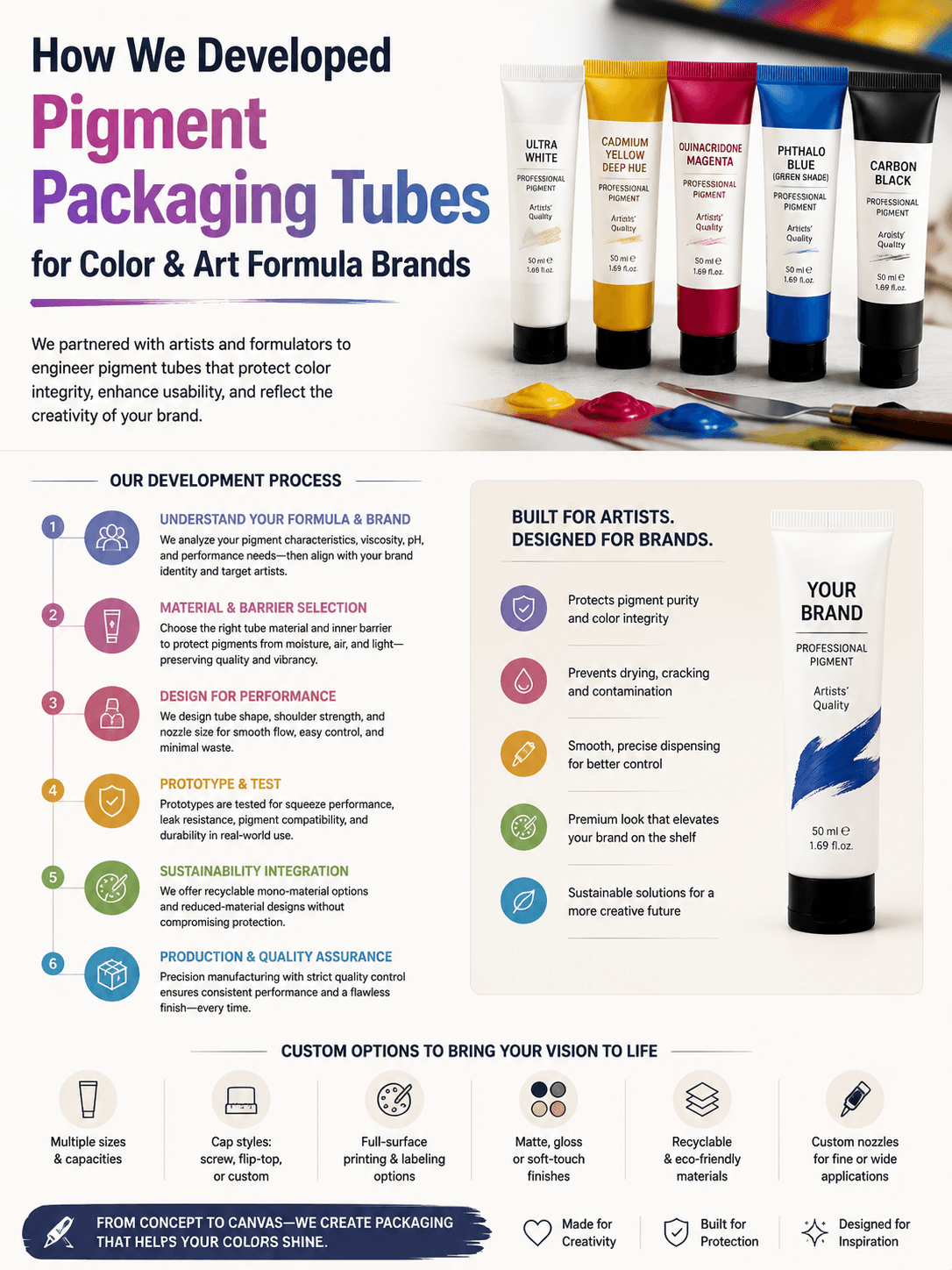
Project Background: Why Pigment Packaging Is Technically Complex
Pigment-based formulations contain high-density color particles, resins, and thick binders that behave differently from standard cosmetic emulsions.
During testing, we identified three core failures in conventional tubes: pigment sedimentation near nozzle area, inner wall staining, and unstable squeeze response over time.
These problems directly impact user experience in professional applications such as nail salons, makeup artists, and industrial color formulation environments.
Key Technical Pain Points Identified
Pigment Residue & Inner Wall Staining
High concentration pigments adhered to tube walls, causing permanent discoloration after repeated use.
Nozzle Clogging in High Viscosity Formulas
Thick pigment gels hardened at the nozzle tip, blocking flow and affecting application precision.
Inconsistent Extrusion Performance
Pressure inconsistency caused uneven pigment output, especially in precision cosmetic or art applications.
Engineering Diagnosis: Why Standard Cosmetic Tubes Fail
Standard PE cosmetic tubes are optimized for lotions and creams, not pigment systems with high solid content and thixotropic behavior.
Without barrier structure, pigment particles migrate and separate, leading to uneven distribution and nozzle blockage over time.
Therefore, we designed a multi-layer EVOH barrier system with inner anti-adhesion coating to stabilize pigment behavior inside the tube.
Factory Engineer Recommendation
We recommend a 5-layer EVOH barrier pigment tube with optimized rheology control and anti-stick inner surface treatment.
This structure solves three core engineering challenges: pigment adhesion, flow instability, and oxidation degradation.
It is especially suitable for nail gel, hair dye cream, acrylic pigment, and professional color systems.
Final Recommended Tube Specification (Engineering Model)
Why We Recommend This Structure (Engineering Logic)
Prevents Pigment Migration
EVOH barrier blocks oxygen and reduces pigment oxidation and separation.
Eliminates Wall Staining
Anti-adhesion coating reduces pigment sticking inside tube walls.
Improves Dispensing Precision
Controlled nozzle ensures stable output for professional use cases.
Project Results
Zero Staining
Inner wall discoloration completely eliminated.
Stable Flow
Consistent extrusion from first to last use.
Extended Stability
No pigment separation during storage cycle.
Client Feedback
“The engineering-grade tube system significantly improved pigment stability and user control. It solved our long-standing clogging and staining issues.”
— R&D Director, Color & Art Brand
FAQ
What tube is best for pigments?
EVOH multi-layer barrier tubes with anti-adhesion coating.
Why do pigment tubes stain?
Due to high particle concentration and lack of barrier protection.
Can you customize nozzle?
Yes, we design precision flow control systems.
Need Engineering-Grade Pigment Packaging?
We help brands design professional pigment tubes for nail, hair, makeup, and art formulations with full OEM/ODM support.