
Mineral Sunscreen Tube Packaging Project
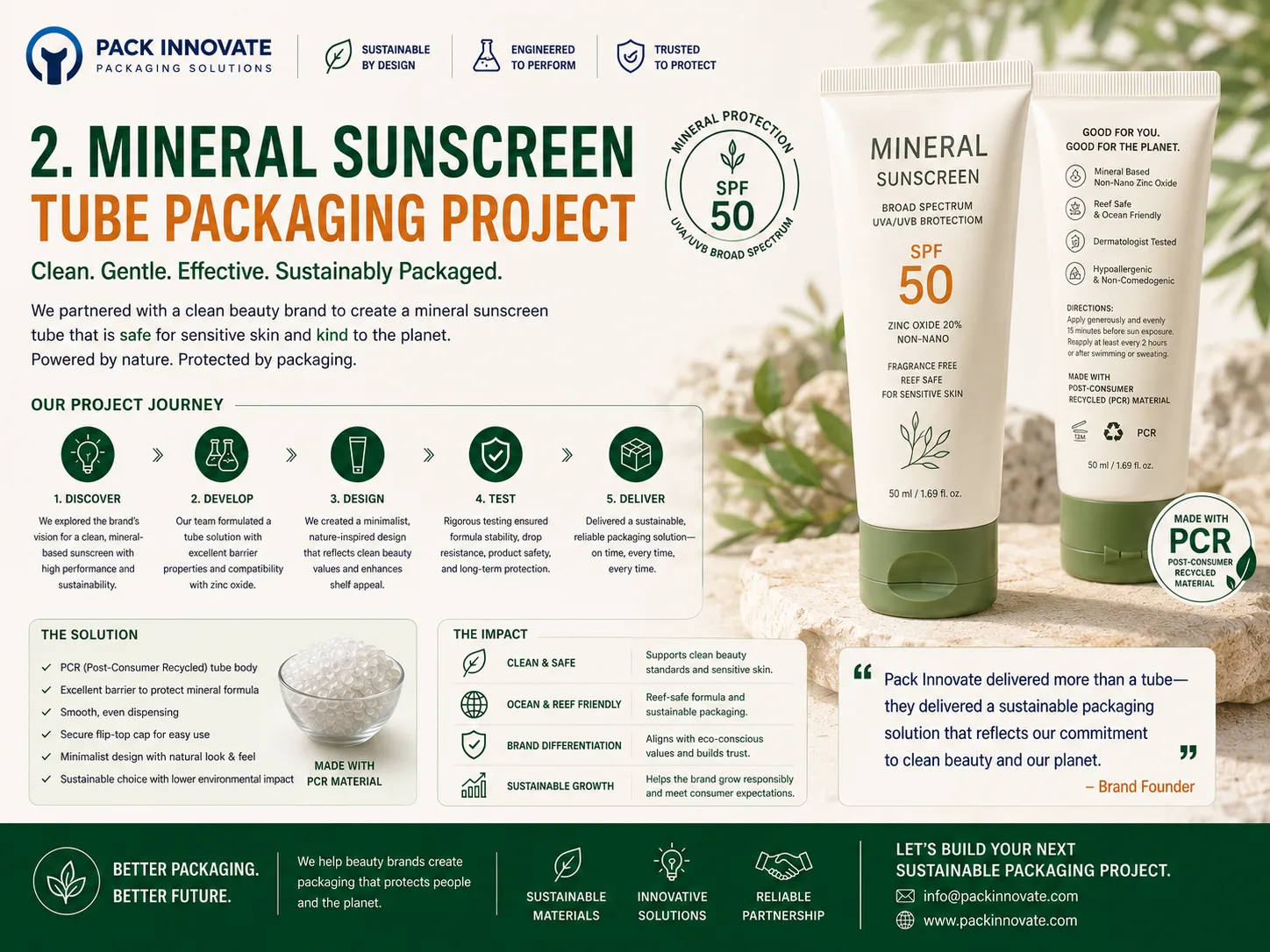
A clean beauty sunscreen brand worked with Xinfly Packaging to develop a mineral sunscreen tube optimized for zinc oxide and titanium dioxide formulas. Unlike regular sunscreen packaging, this project focused on high-viscosity dispensing, enlarged orifice design, tube recovery, formula compatibility, reef-safe positioning, and sustainable material selection.
Project Overview
The customer was preparing to launch a reef-safe mineral sunscreen line for clean beauty retailers, dermatology channels, and outdoor lifestyle consumers. The formula used non-nano zinc oxide and titanium dioxide as physical UV filters, creating a much thicker texture than many chemical sunscreen formulas.
From a packaging engineering perspective, this was not a simple cosmetic tube project. Mineral sunscreen requires careful evaluation of product viscosity, dispensing resistance, shoulder structure, cap design, tube softness, residue control, filling compatibility, and long-distance transportation stability.
After reviewing the customer’s target market and formula characteristics, Xinfly Packaging recommended a customized mineral sunscreen tube solution combining design logic, mineral sunscreen tube experience, and sustainable material options such as PCR cosmetic tubes.
Customer Pain Points Before Development
Thick Formula Dispensing
- Mineral sunscreen with zinc oxide and titanium dioxide had high internal flow resistance.
- Standard tube openings caused difficult squeezing and slow product flow.
- The brand worried that consumers would consider the formula inconvenient to use.
Nozzle Residue & Clogging
- Mineral particles increased the risk of product buildup around the opening.
- Small orifices created uneven dispensing and residue after repeated use.
- The customer needed a cleaner dispensing experience for daily sunscreen users.
Eco-Friendly Brand Pressure
- The brand promoted reef-safe and clean beauty positioning.
- Packaging needed to support sustainability without looking low-grade.
- The material had to balance PCR content, tube appearance, printing stability, and production yield.
Factory Engineer’s Assessment: Mineral Sunscreen Needs Different Packaging Logic
Based on 15+ years of cosmetic tube production experience, our engineers treat mineral sunscreen differently from regular SPF packaging. For chemical sunscreen, barrier and shelf-life protection are often the first priorities. For mineral sunscreen, the first packaging risk is usually dispensing performance.
When a formula contains a high percentage of zinc oxide or titanium dioxide, the tube must help the product flow smoothly without requiring excessive squeezing force. If the orifice is too small or the shoulder angle restricts product movement, the consumer may experience clogging, residue, or poor evacuation. Therefore, our recommendation focused on tube softness, enlarged opening design, cap compatibility, and structure stability before confirming decoration details.
Engineering Analysis and Material Comparison
Before confirming the solution, our team compared several tube structures according to mineral sunscreen viscosity, shelf-life needs, sustainability expectations, and cost control.
Xinfly Packaging Solution
Instead of using a standard sunscreen tube, we developed a mineral-sunscreen-specific structure with improved dispensing comfort and stable decoration performance. The focus was not only “what material to use,” but also “how the formula comes out of the tube.”
Final Tube Specification
How We Solved the Customer’s Key Problems
Large-Orifice Dispensing Design
We recommended an enlarged opening to reduce squeezing resistance and improve product flow. This helped avoid the common mineral sunscreen problem of thick formula buildup around the tube mouth. For similar projects, brands can also consider nozzle tubes when more precise dispensing is required.
Balanced Sustainable Material
Instead of maximizing PCR content blindly, we selected a balanced PCR PE structure to support sustainability while maintaining tube whiteness, surface smoothness, sealing strength, and decoration consistency. This approach is especially important for eco-friendly cosmetic tubes.
Premium Clean Beauty Appearance
The final design used a soft-touch matte surface and minimalist printing to communicate reef-safe, dermatologist-friendly, and premium skincare positioning. This created a different visual language from bright mass-market sunscreen packaging.
What Services We Provided
Formula Compatibility Review
We reviewed formula viscosity, mineral particle characteristics, filling volume, and product flow behavior before recommending tube size and opening design.
Tube Structure Design
We compared PE, PCR PE, EVOH, PBL, and ABL structures and recommended the most practical solution based on brand positioning and formula needs.
Cap & Orifice Matching
We matched the flip-top cap opening with the enlarged tube orifice to improve dispensing performance and reduce residue risk.
Printing & Surface Finishing
We supported Pantone matching, soft-touch matte coating, silk screen printing, and artwork optimization for clean beauty shelf presentation.
Why This Solution Works for Mineral Sunscreen Brands
Better User Experience
Consumers often judge mineral sunscreen by texture and ease of use. A tube that dispenses smoothly helps reduce friction during daily application and improves perceived product quality.
Reduced Packaging Risk
By considering viscosity, opening size, cap compatibility, and filling performance together, the project avoided common issues such as clogging, leakage, weak sealing, and poor product evacuation.
Stronger Reef-Safe Positioning
The packaging supported the customer’s clean beauty message with sustainable material options, minimalist decoration, and a premium tactile finish aligned with reef-safe sunscreen branding.
About Xinfly Packaging
Xinfly Packaging is a professional cosmetic tube manufacturer with 15+ years of production experience. We specialize in custom sunscreen tubes, mineral sunscreen tubes, PCR cosmetic tubes, high barrier cosmetic tubes, matte finish tubes, and OEM/ODM cosmetic packaging solutions.
Our engineering team supports beauty and personal care brands from packaging concept to mass production, including material selection, formula compatibility review, tube structure design, dispensing optimization, cap matching, printing decoration, sample development, mass production, quality control, and export delivery.
For mineral sunscreen brands, our focus is practical: the tube must squeeze well, dispense well, protect the formula, match the brand image, and remain stable in production. Whether you need recyclable cosmetic tubes, sustainable packaging tubes, bioplastic cosmetic tubes, or small capacity cosmetic tubes, we can help you choose a structure that is realistic for both branding and production.
Development Process
Project Results
FAQ About Mineral Sunscreen Tube Packaging
1. Why does mineral sunscreen need special tube packaging?
Mineral sunscreen often contains zinc oxide and titanium dioxide, which create a thicker texture than many chemical sunscreens. The tube opening, shoulder structure, softness, and cap design must be optimized for smoother dispensing.
2. What tube material is suitable for mineral sunscreen?
PE, PCR PE, EVOH barrier tubes, PBL tubes, and ABL tubes can all be considered. The final choice depends on formula sensitivity, viscosity, sustainability goals, shelf life, and budget.
3. Can PCR material be used for mineral sunscreen tubes?
Yes. PCR PE can be used for mineral sunscreen tubes, but the PCR percentage should be balanced with tube color, surface smoothness, printing quality, and mass production stability.
4. Why is a larger orifice useful for mineral sunscreen?
A larger orifice helps thick mineral formulas flow more smoothly, reduces squeezing force, minimizes clogging risk, and improves the consumer experience.
5. Are EVOH barrier tubes necessary for mineral sunscreen?
Not always. EVOH is recommended when the formula needs improved oxygen barrier performance or longer shelf stability. For some mineral formulas, PE or PCR PE structures may be enough after compatibility testing.
6. What cap is best for mineral sunscreen tubes?
Flip-top caps are commonly used because they are convenient and retail-friendly. For thicker formulas, the cap opening should match the tube orifice to avoid flow restriction.
7. Can you make reef-safe sunscreen packaging?
Yes. We provide tube packaging solutions suitable for reef-safe, mineral-based, clean beauty, and eco-conscious sunscreen brands.
8. Can the tube be matte or soft-touch?
Yes. We provide soft-touch matte, regular matte, glossy, and customized surface finishes for premium mineral sunscreen packaging.
9. Can Xinfly help test dispensing performance?
We can provide sample tubes for filling trials, dispensing checks, cap matching evaluation, and transport simulation before mass production.
10. What sizes are common for mineral sunscreen tubes?
Common sizes include 30ml, 50ml, 75ml, 100ml, 150ml, and 200ml. Travel-size and family-size mineral sunscreen tubes are also available.
11. Can mineral sunscreen tubes be recyclable?
Depending on the selected structure and local recycling system, PE-based or PCR PE-based solutions may support recyclability goals better than complex multi-material structures.
12. Can Xinfly support a new sunscreen brand from concept to production?
Yes. We help with material selection, tube structure design, orifice recommendation, artwork adaptation, sampling, mass production, quality inspection, and export delivery.
Developing a Mineral Sunscreen Product?
Tell us your formula viscosity, active ingredients, tube capacity, target market, sustainability goal, and decoration idea. Xinfly Packaging will recommend a practical mineral sunscreen tube structure, dispensing opening, cap option, and printing process based on real factory engineering experience.