

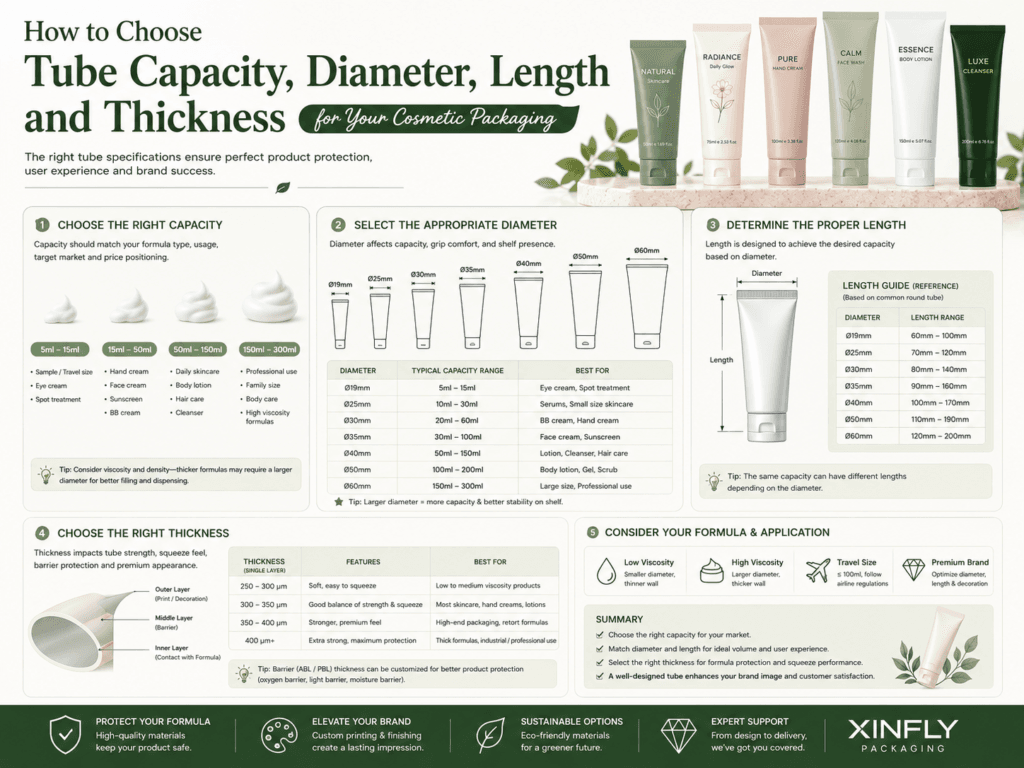
You need to pick the right tube size for your cosmetic packaging. This helps keep your product safe. It also makes it easy for customers to use. Capacity, Tube Diameter, length, and thickness help you match the packaging to your formula and brand. Surveys show that capacity can be small for travel or large for more product. Cap types like stand-up and flip-top are popular because they are easy to use. You should measure both the inside and outside of the tube. You also need to make samples to test your design.
| Parameter Type | Details |
|---|---|
| Cap Type | Stand-up caps, flip-top caps, nozzle caps, fez caps |
| Capacity | Up to 50 ml, 51 ml to 100 ml, 101 ml to 150 ml, above 150 ml |
| Application | Skincare, haircare, makeup, and others |
| Market Insights | Stand-up caps are used the most; flip-top caps are becoming more common; smaller sizes are liked |
Key Takeaways
- Pick the right tube size to keep your product safe. The correct tube stops spills and helps customers use it easily.
- Match tube capacity to the product type. Small tubes are good for eye creams. Big tubes are better for body lotions. Think about how often people use the product.
- Choose the right tube diameter for your product’s texture. Thick creams need wide openings. Thin liquids work well with small diameters.
- Try out your packaging with samples before buying a lot. This helps you avoid mistakes. It makes sure the tube fits your product’s needs.
- Talk clearly with suppliers about what you want. Ask for samples and prototypes. This makes sure the final product matches your brand and quality.
Why Tube Size Matters in Packaging
Product Fit and Protection
You need to make sure your product fits inside the tube. If you choose the wrong tube size, your formula may spill or leak. A tube that is too small can squeeze out too much product. A tube that is too large can waste space and make your packaging look empty. You must protect your formula from air, light, and moisture. The right tube diameter helps keep your product safe. Many skincare products need a tight seal to stay fresh. You can use thicker tubes for fragile formulas. You can use thinner tubes for products that need easy squeezing.
Tip: Always test your packaging with samples before you order large quantities. This helps you avoid mistakes and keeps your product safe.
User Experience and Brand Impact
You want your customers to enjoy using your product. The tube should feel comfortable in their hands. A good tube size makes it easy to squeeze out the right amount. If the tube is too hard to squeeze, customers may get frustrated. If the tube is too soft, it may break or bend. You can choose a tube diameter that matches your product’s texture. For thick creams, a wider tube works best. For gels or liquids, a narrow tube is better. The look of your packaging affects your brand. A well-designed tube shows quality and care. Customers remember brands that use smart packaging.
- Easy-to-use tubes build trust.
- Attractive packaging helps your product stand out.
- The right tube size makes your brand look professional.
Determining Tube Capacity
Matching Capacity to Product Type
You need to pick the right tube size for your product. Capacity means how much fits inside the tube. Think about how customers use your product. Eye creams and spot treatments need small tubes. These tubes hold between 15 and 20 ml. Serums and active treatments need about 30 ml tubes. Face creams and moisturizers use tubes between 30 and 50 ml. Hair masks and intensive treatments need bigger tubes. These tubes hold between 100 and 150 ml. Leave-in conditioners and styling creams fit in tubes between 50 and 100 ml. Body lotions and scrubs use tubes between 100 and 150 ml.
Tip: Think about how often customers use your product. Daily-use products need bigger tubes. Special treatments or travel-size products need smaller tubes.
You should also think about how thick your formula is. Thick creams need wider tubes with more space. Thin liquids or gels work well in smaller tubes. Matching tube size to product type helps customers. They feel happy when the tube fits their needs. You can stop waste and make your packaging look good.
Standard Cosmetic Tube Capacities
You can find common tube sizes for many cosmetic products. These sizes help you pick the right tube for your formula. Many brands use these sizes to make packaging easy and nice.
- Eye creams / spot treatments: 15–20 ml
- Serums / active treatments: 30 ml
- Face creams / moisturizers: 30–50 ml
- Hair masks and intensive treatments: 100–150 ml
- Leave-in conditioners and styling creams: 50–100 ml
- Body lotions and scrubs: 100–150 ml
Tube size can change by region or market. The table below shows how different sizes fit different markets.
| Tube Capacity | Market Segment | Growth Rate | Share | Key Drivers |
|---|---|---|---|---|
| Medium (50-150ml) | Family-sized products | Fastest | 30% | Demand for multi-use packaging and consumer convenience |
| Small | Travel-size, sample packaging | Steady | N/A | Compact systems for high-speed equipment |
| Large | Industrial products, bulk formulations | Growing | N/A | Cost efficiency and operational optimization |
Medium tubes are good for family-sized products. These tubes are growing fast in the market. Small tubes are best for travel-size and samples. Large tubes fit industrial products and big batches.
Pick the right tube size for your product and market. You can make customers happy and stop waste. You can also help your packaging stand out in stores. Test your tube size with samples before you order a lot. This helps you avoid mistakes and keeps your product safe.
Selecting Tube Diameter
Diameter for Different Product Types
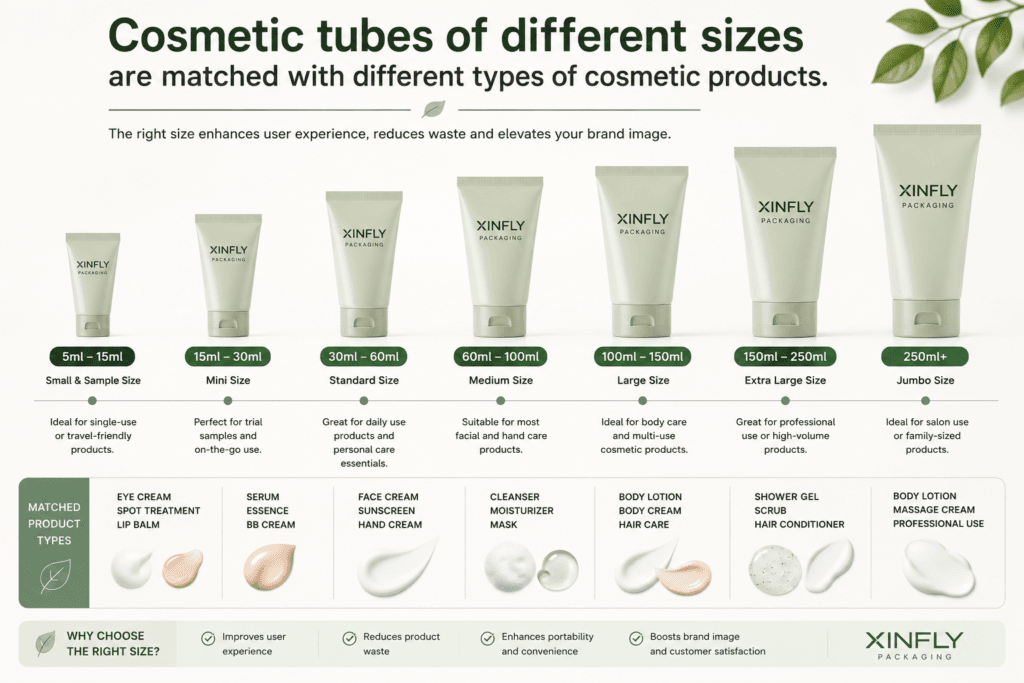
You need to pick the right tube diameter for your product. Tube diameter changes how your product comes out. It also changes how people feel about your packaging. You can measure tube diameter by looking at the width of the tube opening. This helps you see if your product will fit and look nice. A tube diameter size chart can help you compare choices.
- Thick products like balms and creams need bigger tube diameters. This makes it easier for people to squeeze out the product.
- Thin products like gels and liquids use smaller tube diameters. These tubes help control how much comes out and stop spills.
- You should use a tube diameter size chart to find the best size for your product.
Matching tube diameter and wall thickness to your product’s thickness makes people happier. Thick creams often need a bigger diameter and stronger walls. Thin liquids can use a smaller diameter and thinner walls. Two products with the same amount inside may need different tube diameters because of thickness.
What people like also changes tube diameter. Many people like twist-up tubes for lip balms because they are easy to use. Push-up tubes are getting more popular because they look different. You can use a tube diameter size chart to pick the best size for your customers.
Inner vs. Outer Tube Diameter
You need to know the difference between inner and outer tube diameter. The inner diameter shows how much product fits inside. The outer diameter changes how the tube looks and feels in your hand. A tube diameter size chart can help you compare both measurements.
- The neck finish size includes outer diameter, inner diameter, and height. These sizes help you pick the right cap or closure.
- The outer diameter makes sure the closure fits tight. The inner diameter gives enough room to fill the tube.
- The thread depth and neck height help the cap line up with the tube.
You should always check both inner and outer tube diameter before you finish your packaging. This helps stop leaks and makes sure your tube size fits your product and brand.
Choosing Tube Length
Length for Branding and Ergonomics
You should think about tube length when you design your cosmetic packaging. The right length gives you more space to show your brand. You can print your logo, product name, and important details on the tube. A longer tube gives you a 360-degree printable surface. This helps your brand stand out on the shelf. Modern printing lets you add high-definition graphics and even QR codes. These features can boost your brand’s appeal and help you connect with customers.
- A longer tube gives you more room for clear branding and product information.
- You can use the extra space for bright colors and bold designs.
- The right tube length makes your product look good and easy to spot in stores.
- You can match the tube length to your brand’s style and the people you want to reach.
You also need to think about how the tube feels in your customer’s hand. The length should fit well in the hand and make it easy to squeeze out the product. If the tube is too long, it may feel awkward. If the tube is too short, it may be hard to hold and use.
Measuring Internal Tube Length
You need to measure the internal tube length to make sure your product fits well. Start by measuring from the bottom of the tube to the shoulder, not including the cap. This gives you the space inside the tube for your product. You should check the length with a ruler or a caliper for accuracy.
- Always measure the inside of the tube, not just the outside.
- Make sure the length matches the amount of product you want to fill.
- Test the tube with your formula to see if the length works for squeezing and storage.
Choosing the right tube length helps you avoid waste and gives your customers a better experience. You can make your tube size match your product and your brand. This step is important for every cosmetic packaging project.
Tube Wall Thickness and Durability
Protection for Fragile Products
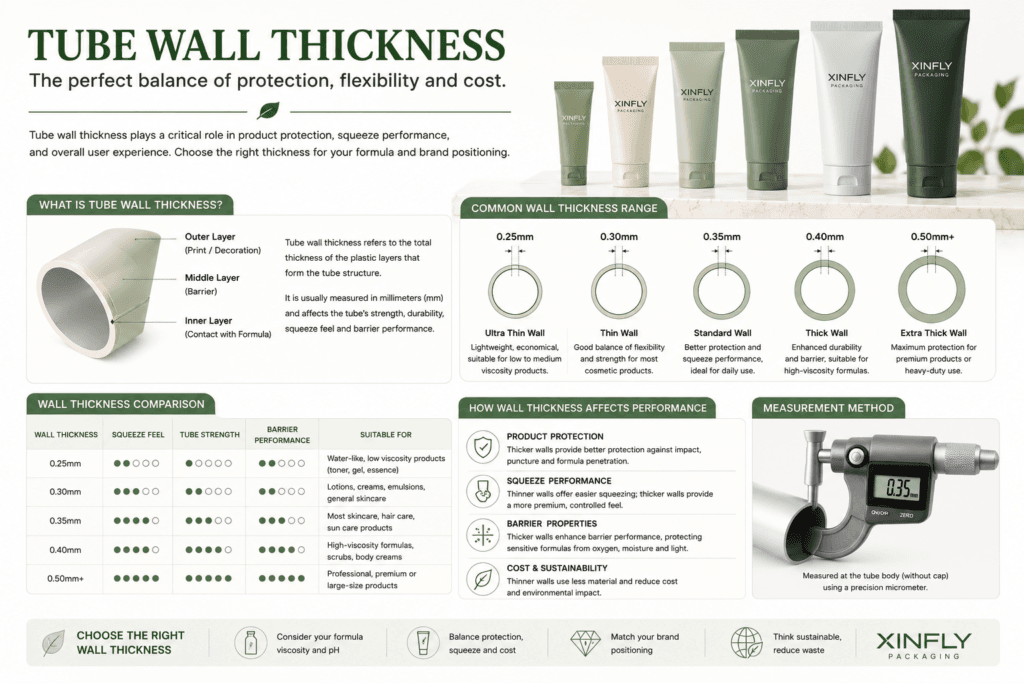
You need to choose the right wall thickness for your tube when you want to protect fragile formulas. Thicker walls help keep your product safe from bumps and drops. If you use a thin wall, your tube may crack or leak. Many skincare formulas need extra protection because they break down easily. You can use a thicker tube to block air and light. This keeps your product fresh for longer. You should check the diameter and wall thickness together. A wide diameter with thin walls may bend too much. A narrow diameter with thick walls feels strong and sturdy.
Note: Always test your tube with your formula before you order a large batch. This helps you see if the wall thickness gives enough protection.
You can use different materials for your tube. Some materials need more wall thickness to stay strong. LDPE tubes often use a wall thickness between 0.4 and 0.6 mm. HDPE tubes use a wall thickness between 0.45 and 0.65 mm. You should match the wall thickness to your product’s needs. If your formula is fragile, pick a tube with thicker walls.
Squeezability and Quality Perception
Wall thickness changes how your tube feels when you squeeze it. If you use a tube with thin walls, it feels soft and easy to squeeze. Thick walls make your tube feel firm and strong. You can see the difference in the table below:
| Tube Type | Wall Thickness Range | Squeeze Feel (1-5) |
|---|---|---|
| LDPE | 0.4–0.6 mm | 1–2 |
| MDPE | 0.4–0.6 mm | 3 |
| HDPE | 0.45–0.65 mm | 4–5 |
You should pick the wall thickness based on how you want your tube to feel. If you want a soft squeeze, use LDPE with lower wall thickness. If you want a firm squeeze, use HDPE with higher wall thickness. Many customers think thick walls mean better quality. A tube with the right wall thickness shows your brand cares about packaging. You should balance wall thickness, diameter, and tube size to make your product easy to use and look professional.
Tip: Try different wall thickness levels with samples. This helps you find the best feel for your customers.
Practical Tube Size Frameworks
Mapping Product Types to Tube Size
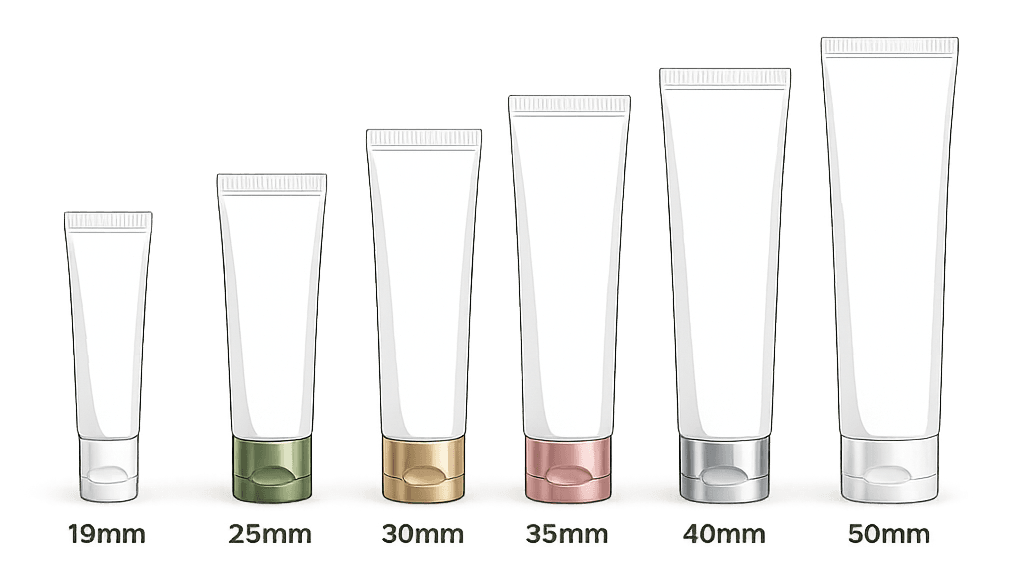
You need a clear framework to match each cosmetic product to the right tube. This helps you avoid mistakes and makes your packaging look professional. The table below shows common product types and the best tube size for each. You can use this as a quick guide when you plan your next project.
| Product Type | Capacity | Diameter Range | Length Range |
|---|---|---|---|
| Eye creams / spot treatments | 15–20 ml | 16–19 mm | 70–90 mm |
| Serums / active treatments | 30 ml | 22–25 mm | 90–115 mm |
| Face creams / moisturizers | 30–50 ml | 25–30 mm | 100–130 mm |
| Hair masks / intensive care | 80–100 ml | 30–35 mm | 120–160 mm |
| Body lotions / scrubs | 100 ml | 30–35 mm | 130–160 mm |
You can also see the range of tube diameters for each capacity in the chart below:
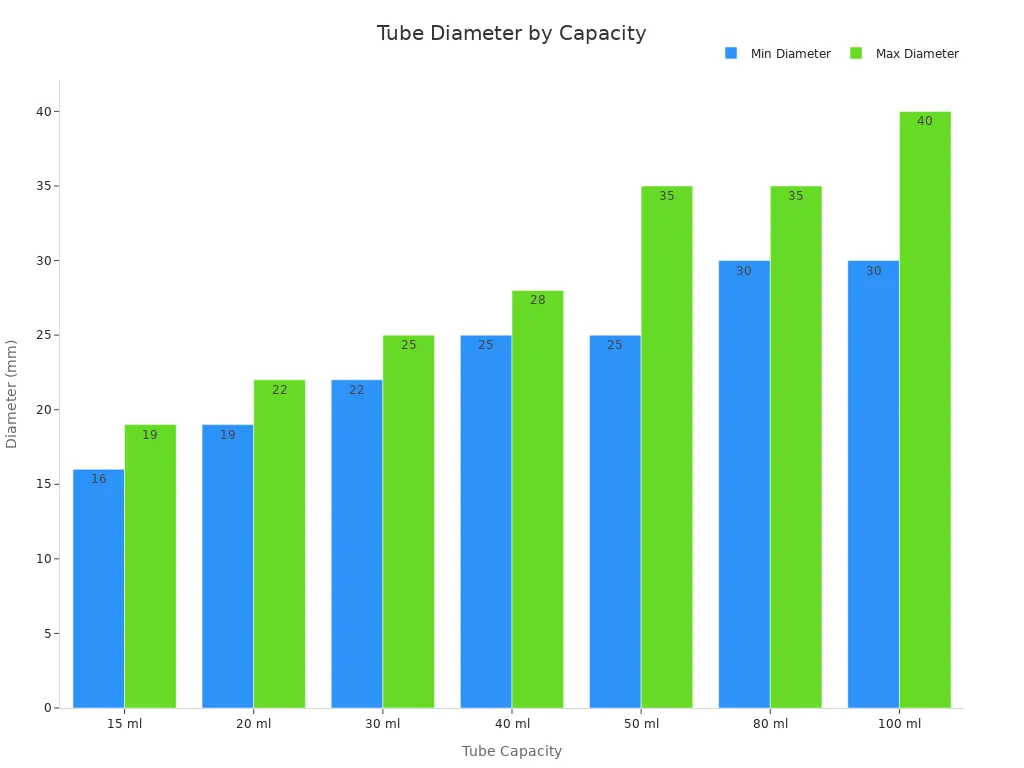
Let’s look at three examples:
- A 15 ml eye cream works best in a 16 mm diameter tube with a length of 75 mm and a thicker wall for protection.
- A 30 ml serum fits well in a 22 mm diameter tube, 100 mm long, with a medium wall thickness for easy squeezing.
- A 100 ml body lotion needs a 35 mm diameter tube, 150 mm long, with a standard wall for daily use.
You can ask Xinfly Packaging for samples and prototypes. This lets you test your formula with different tube sizes before you order in bulk.
Mailing Tube vs. Cosmetic Tube Comparison
You might wonder how a mailing tube compares to a cosmetic tube. A mailing tube is made for shipping papers or posters. It has a thick wall and a large diameter. It protects items from bending. A cosmetic tube is made for creams, gels, or lotions. It has a smaller diameter and a softer wall. You can squeeze it to get the product out.
Key differences:
- Mailing tube has a hard shell and does not squeeze.
- Cosmetic tube is soft and flexible for easy use.
- Mailing tube protects from crushing, while cosmetic tube protects your formula and helps with daily use.
You should never use a mailing tube for cosmetic products. Always choose a cosmetic tube that matches your product’s needs. Xinfly Packaging can help you pick the right tube for your formula and brand.
Common Packaging Mistakes
Overlooking Formula Compatibility
You might think all tubes work for every formula, but that is not true. Many cosmetic formulas contain oils, acids, or essential oils. These ingredients can react with the tube material. If you skip compatibility testing, you risk swelling, cracking, or softening of the tube. Sometimes, the tube looks fine at first, but problems appear later. You may see leaks, color changes, or even strange smells.
- Always test your final formula in the tube you plan to use.
- Try both real-time and fast testing to see how the tube holds up.
- Watch for changes like distortion, odor, or seal failure.
Tip: Aggressive formulas need extra attention. Check for print fading or seal problems before you choose your tube.
Testing helps you avoid costly mistakes. You protect your product and your brand when you match the right tube to your formula.
Ignoring Consumer Needs
You want your customers to enjoy using your product. If you ignore their needs, you may choose the wrong tube size or shape. Many brands make these common mistakes:
- Picking tube size based only on capacity. This can make your product look odd on the shelf.
- Skipping squeezability tests. The tube may be too hard or too soft for your formula.
- Forgetting how the tube looks online. A tube that looks good in person may not look good in e-commerce photos.
- Overlooking how the tube fits into cartons or filling lines. This can slow down your operations.
You should always test the tube with your real formula. Ask for feedback from users. Make sure the tube feels good in the hand and works well every day.
Note: The right tube makes your packaging stand out and keeps your customers happy.
Choosing the right tube and avoiding these mistakes will help your product succeed.
Finalizing Tube Specs with Suppliers
Step-by-Step Process
You need to follow clear steps when you finish tube specs with suppliers. First, think about what your product needs. Decide the tube size, capacity, diameter, length, and wall thickness. Make sure your formula fits inside the tube. Tell your supplier what you want. Ask for samples to test your product and see if it fits.
Suppliers like Xinfly Packaging help you make samples and prototypes. You can look at different sample types to pick the best one for your packaging:
| Sample Type | Description |
|---|---|
| Design Samples | Tubes with printed artwork for checking looks and showing others. |
| Material Samples | Tubes without printing in chosen materials for testing how they bend and work with your formula. |
| Pre-Production Samples | Samples for final approval that are almost the same as the ones made in large amounts. |
You should test each sample with your formula. Check if the tube squeezes easily, lasts long, and looks good. Make sure the tube size fits your brand and product. Look at the samples and tell your supplier what you think. This step helps you stop mistakes before making lots of tubes.
Tip: Always ask for pre-production samples. These samples show you how your tube will look and feel.
Key Questions for Xinfly Packaging
You need to ask important questions when you talk to Xinfly Packaging. These questions help you get the best tube for your product.
- How much do you need?
- What tube structure do you want (material, size, barrier)?
- What decoration do you need?
- What are your goals for being eco-friendly?
- What is your budget?
- When do you need the tubes made?
You should also think about which material and barrier structure to use. Talk about custom designs and eco-friendly choices. These questions help you find the right tube and avoid problems.
Note: Talking clearly with your supplier helps your packaging project succeed.
You can pick the right tube for your cosmetic product by doing these steps:
- Decide how much product you want in the tube, how much you want to spend, and what the product will do.
- Work with your supplier to choose the tube diameter and material.
- Make a chart to show sizes for all your products.
- Check samples and drawings to make sure everything is correct.
Making prototypes lets you try out the packaging and hear what users think. You can fix any issues before selling your product. Suppliers like Xinfly Packaging give helpful advice and special options. After that, match your tube design to your formula, order samples, and check if the quality is good.
Looking for Standard International Tube Dimensions with More Flexible Tooling Options?
Are you a packaging engineer, formulation chemist, or brand manager matching a strict fill-capacity requirement for your beauty line? Xinfly Packaging provides full-scale compatibility charts, comprehensive dimensional specifications, and custom tooling development with significantly shorter lead times than rigid, traditional conglomerates.
Whether you are designing a sleek oval foundation tube or a high-barrier 5-layer EVOH sunscreen tube, our technical toolkit below is built to streamline your blueprinting and sourcing process.
Free Cosmetic Tube Die-line Template Downloads
Download professional cosmetic tube die-line templates optimized for Adobe Illustrator workflows, packaging engineering, and custom printing preparation. All layouts include bleed lines, sealing safety areas, and accurate structural dimensions.
19mm Round Tube Die-line Template
Ideal for lip gloss, eye cream, spot treatment serums, and mini skincare packaging.
📁 Download PDF22mm Round Tube Die-line Template
Suitable for facial cleansers, travel skincare products, and cosmetic sample tubes.
📁 Download PDF25mm Round Tube Die-line Template
Recommended for sunscreen tubes, primers, daily skincare products, and hand creams.
📁 Download PDF30mm Round Tube Die-line Template
Designed for BB cream, facial cleanser, moisturizer, and cosmetic squeeze tubes.
📁 Download PDF35mm Round Tube Die-line Template
Optimized for foundation tubes, sunscreen packaging, and premium skincare products.
📁 Download PDF40mm Round Tube Die-line Template
Suitable for high-barrier EVOH sunscreen tubes and larger cosmetic formulations.
📁 Download PDF45mm Round Tube Die-line Template
Recommended for hair treatment tubes, salon products, and body care packaging.
📁 Download PDF50mm Round Tube Die-line Template
Perfect for shampoo tubes, conditioner packaging, hair masks, and large-capacity beauty products.
📁 Download PDFFrequently Asked Questions About Cosmetic Tube Capacity, Diameter, Length and Thickness
Learn how to choose cosmetic tube capacity, tube diameter, tube length and tube thickness for skincare tube packaging, custom cosmetic tubes, PE cosmetic tubes, OEM cosmetic tube manufacturing and private label cosmetic packaging projects.
How do I choose the right cosmetic tube capacity?
What is the standard diameter for cosmetic tubes?
How does tube diameter affect cosmetic packaging design?
How do I choose cosmetic tube length?
Why is cosmetic tube thickness important?
What tube capacity is best for skincare packaging?
Can cosmetic tube size be customized?
How does formula viscosity affect tube size selection?
What tube size is suitable for sunscreen packaging?
Can tube thickness improve product protection?
What should I confirm before producing custom cosmetic tubes?
Why choose Xinfly Packaging for custom cosmetic tube sizing?
Need Help Choosing the Right Cosmetic Tube Size?
Xinfly Packaging helps skincare and beauty brands select the right tube capacity, diameter, length and thickness based on formula compatibility, product positioning, custom printing, filling requirements and OEM cosmetic packaging goals.
